 |
 Welcome. It’s summertime, and you know what that means in our journal—reruns. Welcome. It’s summertime, and you know what that means in our journal—reruns.
But not the lazy kind. The kind where you go back, read again, and realize, this actually hits harder now.
Reflections in the pool or in the mind, as things slow down this time of year, bring back a few episodes that age well. Or at least the ideas do. Because leadership advice can get stale fast, especially in industries where change is a constant every five minutes. Over the years we’ve asked many air cargo people a simple question that somehow never has a simple answer: what is great leadership?
And one conversation in particular has stuck with us.
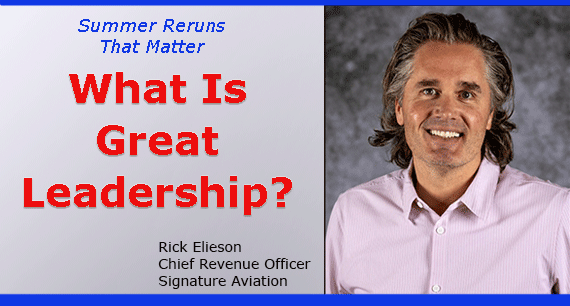
Back in 2019, we sat down with Rick Elieson. At the time, he was President of American Airlines Cargo.
Fast forward to now, and Rick’s in a different seat entirely: he’s Chief Revenue Officer of Signature Aviation.
Which is kind of perfect for this question.
Because if your leadership ideas only work when you have one specific title, or one specific set of problems, are they really leadership ideas?
All of this got us thinking about that old saying: what goes around comes around. Would what Rick said about leadership a half dozen years ago still stand up in 2026?
And not just stand up in theory, but actually feel true now, after everything the industry has been through and how much the world of work has shifted.
Because leadership isn’t frozen in time. The world changes, technology changes, markets change, people change. What stays constant?
So in a ‘gone is not forgotten’ move we sent this article to Rick requesting his permission to share it again with you, dear reader and he replied:
“I enjoyed re-reading this so much! It brought back many fond memories and I remain as proud of the AA Cargo team today as ever! Thank you for publishing it and I’d be honored for you to do so again!”
So here from Rick Elieson is a blast from the past. Enjoy an abridged, albeit deep-dish offering of just what it takes to be a leader in air cargo:
“For many years I have made a practice of trying to identify leadership qualities in the people around me. I don’t mean this in a judgmental or critical way, but I’ve looked for habits and practices that I might emulate and from which I will grow. I don’t want to have to learn everything first-hand through my own trial and error process. I’ve found that if you’re willing to look, there are wonderful teachers all around (even if unwittingly) and there are a great many leadership attributes that I have come to admire. Attributes like passion, authenticity, humility and a vision rank high on my list. Of course, so does good communication skills and good managerial skills. I think of leadership and management as quite distinct, but I appreciate the need for both and don’t believe either can be neglected if an organization is to thrive. (Abridged) As the American Airlines Cargo team, we emphasize five leadership principles in particular. We don’t generally talk about them in any particular order (one isn’t more important than another), but in my mind, there is a logical sequence or momentum to them.
First is Caring. Specifically, caring about your fellow team members. And more to the point, helping them to feel cared for. It isn’t enough for me to sit quietly and think kind thoughts about my colleagues. Potential energy needs to be put into motion in order to unlock its value. (Abridged) . . . we try very hard to be inclusive and treat third party employees the same as any other team member. That is the kind of thoughtful approach to caring that is infectious and I’m proud to say permeates and perpetuates a family-like culture of caring among our team.
Second is Collaboration. When you like your colleagues and truly value their input, you are more likely to include them and collaborate. So, if you are aligned in your cause (your purpose and your understanding of its relative urgency), you care about each other and you appreciate the contribution of your fellow team members, then it quite naturally turns into great collaboration. None of us have a monopoly on the best ideas. I don’t know if I’ve ever had the best idea in the room. But I’ve contributed to some brilliant ones, and I’ve implemented many. I can say with confidence that the proudest accomplishments in my career, crowning achievements if you will, are ideas that originated with someone else. Many examples immediately spring to mind.
One thing that social science and design thinking has taught us is that ideas get better when you share them. (Abridged) The result is not only that initiatives become more thoughtful and robust, but they are more successful because all of the people responsible for implementation become involved and invested along the way. I know American is not the only gigantic company where this is helpful – it must be true at forwarders and other carriers and other corporations.
Third is Development. We can always improve, right? However, the effort to do so often gets sidelined because we’re too busy doing our day job. When my father was my age, he went back to school to earn a PhD. He already had degrees from Caltech and Harvard. What was more education going to do for him? I have grown up with his example of lifelong learning. Not to get existential on you, but I am convinced that when you stop growing, you start dying. One of the interesting things about deepening or broadening your knowledge is that it not only makes you smarter, but when you flex your mind in new ways or examine old problems in a new context – and then share what you’re learning – it improves the way in which you interact with others. Great leaders do more than continue to learn and improve, they also recognize that core to their responsibility is helping others do the same.
The next leadership is Results. Results matter, and getting stuff done is a hallmark of great leadership. We have a lot of cool initiatives, but none of them matter if you are not living up to your commitments of today. (Abridged) You cannot afford to be so distracted by what lies ahead that you neglect the problem at hand – that only ends in disaster. You must master the challenges in front of you right now.
There is an inseparable relationship between how hard we work for something and how much we value it. The harder we work, the more we care about it. And the more we care about something, the harder we are willing to work for it. Said another way, you care most about the people you serve the most. It may sound like circular logic, but I prefer to think of it as a virtuous cycle. (Abridged)
The final attribute is Future. I was a Boy Scout, so being prepared is deeply engrained in my psyche. The comforting news is that I don’t have to predict the future in order to prepare for it. Once upon a time, the companies with the smartest people or the greatest access to resources were the most successful. In the modern economy, that simply isn’t true anymore. Start-ups appear out of seemingly nowhere and with next to nothing disrupt established markets all the time. The most resilient companies, the enduring companies that are successful over the long haul, are the companies that are the most adaptive and the most attuned to customer needs. Technology is at the core, but it isn’t the focus. Technology is an enabler, while people and process are – must be – at the center of your long-term strategy.
[In conclusion] we are at our best when we recognize, appreciate and leverage the unique strengths that each of us brings to the table as opposed to trying to accomplish feats alone or to force others to conform. People have always liked me better after meeting my wife, they think I’m funnier after seeing me with my friends, and they only see how capable I am when they get to know my team. However you choose to slice it, we are better together, and we are happier when we are focused on the happiness of others.”
For our readers: if you ever decide that you want to focus your career to become a real leader, we are more than happy that we have given you very good guidance in this special presentation from Rick Elieson. Thanks, Rick.
Geoffrey Arend |








 100%
Green
100%
Green