 |
Can we tell you a story of spirit and centenary and a homecoming?
In 2026, FIATA, the International Federation of Freight Forwarders Associations in English, (its acronym comes from its original French title: Fédération Internationale des Associations de Transitaires et Assimilés) turns 100 years old, and it’s celebrating this October 9th in Milan, Italy.
There’s something grounding and very compelling about that in the world of logistics.
A global organization pausing long enough to look back at its first steps, then stepping forward again—wiser, sharper, and still curious.
And it’s not just FIATA that feels iconic in Milan. When people think of the city, they picture fashion, design, and business.
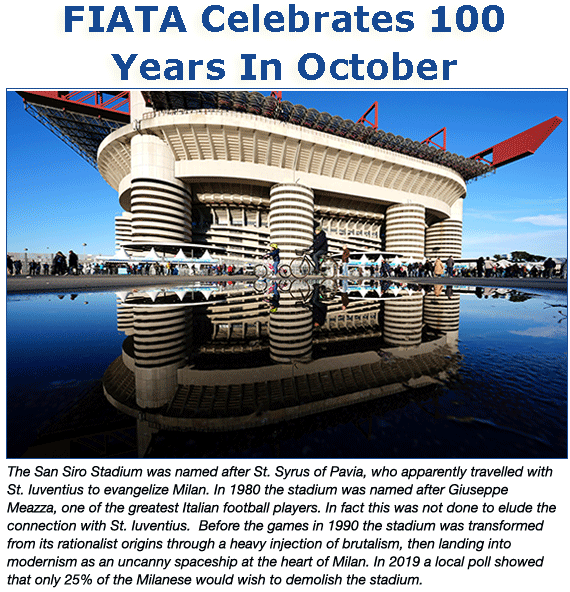
But there’s also that dramatic landmark near the conversations: San Siro, that opened (September 19) in Milan in the very same year FIATA was founded in Vienna (May 31, 1926). Two centenaries in the same city, almost in dialogue with each other.
Two forces one in sports: bold, unmistakable, built for crowds and emotion and the other with the quiet power of an international federation that helped freight forwarders organize, speak with one voice, and shape how trade moves.
Different worlds at first glance, yet both are about connection, scale, and what it means for a city to host something that lasts.
San Siro reimagined in 2016 is famous for its dramatic brutalist architecture: concrete towers and those spiraling ramps, and it holds more than 75,000 people. It’s a temple of sport, but it’s also a reminder that big structures endure when they’re designed with purpose.
FIATA’s story has that same feeling: a framework built to support an industry through change.
The FIATA World Congress celebrating 100 years takes place in Milan from October 6th to 9th, 2026, hosted at the MiCo Milano Convention Centre, co-organized with Fedespedi.
The theme says a lot in just three words: “Empowering Global Logistics.”
Not “watching it happen,” not “hoping it works out.” Empowering!
When at arm’s length you look at what the freight forwarding sector is facing, it makes sense.
Change isn’t a future tense anymore. It’s the daily weather.
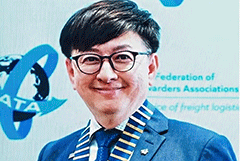 FIATA President Professor Doctor Thomas Sim has been clear about the pressures: geopolitical uncertainty reshaping routes, technology transforming how freight is managed and tracked, and sustainability moving from a promise on paper to something that has to function operationally. FIATA President Professor Doctor Thomas Sim has been clear about the pressures: geopolitical uncertainty reshaping routes, technology transforming how freight is managed and tracked, and sustainability moving from a promise on paper to something that has to function operationally.
There’s also the rising expectation from customers and regulators. The bar keeps going up. And that can sound exhausting, but it can also be clarifying. Because once you accept that the world is more compliance-driven and more disrupted, the question becomes: what keeps trade competitive and resilient?
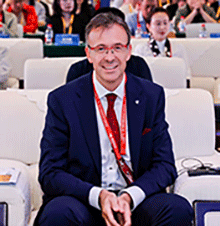 FIATA’s Director General, Doctor Stéphane Graber, has been emphasizing a very practical answer: trusted information flows. FIATA’s Director General, Doctor Stéphane Graber, has been emphasizing a very practical answer: trusted information flows.
Not just more data—better data. Interoperable, actionable, and credible across borders and across modes of transport.
This is where the discussion gets concrete. Because one topic expected to surface in Milan is how negotiable cargo documents can help digital transformation actually work in real cross-border transport, not just in slide decks.
A key example is the eFBL, the electronic FIATA Bill of Lading. In plain terms, it’s the digital version of the traditional paper negotiable FIATA Multimodal Transport Bill of Lading.
But what matters isn’t that it’s electronic for the sake of being modern.
What matters is what it enables: trusted shipment data captured at source, and a foundation for systems to talk to each other without losing reliability.
Because resilience isn’t just about having backup options. Resilience is about speed with confidence. It’s about being able to reroute, shift modes, and stay compliant without the entire chain slowing down or breaking apart.
And there are broader frameworks supporting that direction too, like work connected to the UNCITRAL NCD Convention, which links to the wider push for electronic trade documentation.
The point is to make trade more agile and more secure at the same time—no small task.
So armed with issues, if you’re picturing Milan in October 2026, picture a centenary that’s not just ceremonial.
Yes, there will be celebrations. Yes, there will be that special feeling of being near the birthplace of FIATA. But there will also be the practical atmosphere of a working industry: smart sessions, serious debate, networking, and space for companies to show what they’re building.
Perhaps in between meetings, a moment to step outside and feel the city. To remember that this isn’t only a conference—it’s a return to roots. Milan is where freight forwarders took a big step toward organizing globally a century ago. Coming back is a way of saying: we still recognize what started here, and we’re ready for what comes next.
A hundred years is long enough to prove you’re not a trend.
You’re a community.
If the next era of logistics is going to be defined by trusted digital systems, sustainability that holds up in the real world, and trade routes that keep changing shape—then gatherings like this matter, because they turn pressure into shared direction.
So here’s the invitation, in the gentlest, most grounded way: if global logistics is part of your life, Milan 2026 is a moment to mark.
A moment to celebrate FIATA at 100, to learn, to connect, and to help shape what “empowering global logistics” will mean in practice.
As FIATA gets back to where it once belonged in Milan—near that unforgettable stadium that also began its story in 1926—there’s a quiet symmetry to it.
Big structures. Big crowds. Big responsibility.
Underneath it all, a simple idea: when we move goods well, we support lives, businesses, and futures.
A historic gathering:
Register today and be part of these historic event: https://fiata2026.com
Geoffrey Arend
FIATA Fellow 2016
|






 100%
Green
100%
Green