
|
 |
 #INTHEAIREVERYWHERE |
 |
| Vol. 25 No. 35 | Thursday August 13, 2026 |
 |
|
|
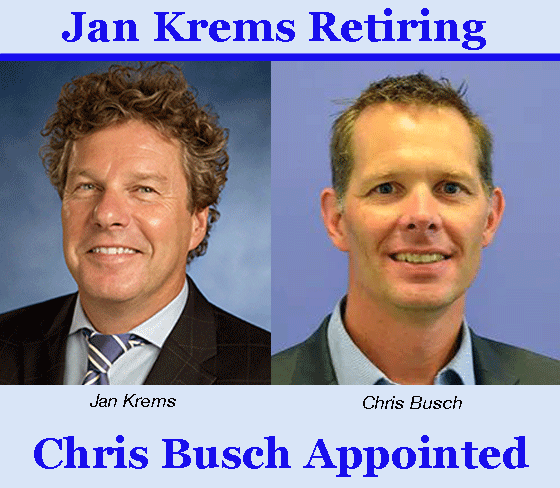
Blockbuster mid-summer 2026 news from United Airlines Cargo, as Andrew Nocella, United’s Executive Vice President and Chief Commercial Officer announced that Jan Krems, President of UA Cargo is retiring. |
 |
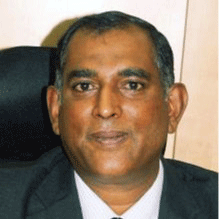 Captain Preetham Philip runs an airline most Indians will never notice — and he's fine saying so. "If all my aircraft were grounded tomorrow, nobody would know," says the CEO of Quikjet Cargo Airlines, India's only scheduled all-cargo carrier outside express giant Blue Dart. "A package would arrive three days later. That's all." Captain Preetham Philip runs an airline most Indians will never notice — and he's fine saying so. "If all my aircraft were grounded tomorrow, nobody would know," says the CEO of Quikjet Cargo Airlines, India's only scheduled all-cargo carrier outside express giant Blue Dart. "A package would arrive three days later. That's all." That invisibility, he argues, is the defining feature of Indian air freight: essential to e-commerce, pharma and perishables, yet structurally disadvantaged and poorly understood. After a decade in the business, his verdict is blunt: "Most cargo airline models simply don't work in India." The reasons are economic. Unlike Europe or North America, India can truck almost anything. "If I can truck it for two rupees, why send it by air for 80?" Even air's speed edge erodes in handling: a Delhi–Bengaluru shipment eats roughly 12 hours door-to-door against a truck's 36. "We're a price-sensitive market, not a service-level-sensitive one." Passenger carriers compound the squeeze. For an IndiGo or Air India, belly cargo is incremental income; for Philip it's everything. "The belly operator can charge ₹25 a kilo because cargo isn't his business. For me, it's my only revenue." Freight flows are lopsided too — "I can get loads from Delhi to Bengaluru, but maybe not back. Everything is unidirectional" — leaving freighters hunting return payloads passenger routes never have to. Philip is notably even-handed on the regulator, reserving his criticism for policy design — schemes such as Krishi Udaan that, he says, miss the airports where farm cargo most needs them. His prescription borrows from China: targeted support that seeds markets until they stand on their own. "If a city grows through aviation, the whole city grows." As for the future, his answer is one word: "Drones." He envisages large autonomous freighters carrying one to four tonnes, feeding trunk routes flown by conventional jets and reaching places — Leh, the Himalaya, remote islands — that no timetable can justify today. The technology is coming, he says; the rules will lag and won't be written in India. "If you can go to space and back without a human, why can't you go from one airport to another?" Quikjet's own path stays firmly on freight. "Passenger is not something I'll ever get into." The mission is cheaper, broader air cargo built for India's particular geography — and an acceptance that this story will copy no one else's. "If I can make air freight cheaper and accessible to larger volumes," he says, "then everything changes." Tirthankar Ghosh |
 |
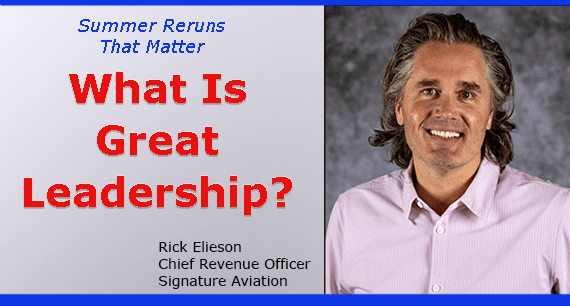
Second is Collaboration. When you like your colleagues and truly value their input, you are more likely to include them and collaborate. So, if you are aligned in your cause (your purpose and your understanding of its relative urgency), you care about each other and you appreciate the contribution of your fellow team members, then it quite naturally turns into great collaboration. None of us have a monopoly on the best ideas. I don’t know if I’ve ever had the best idea in the room. But I’ve contributed to some brilliant ones, and I’ve implemented many. I can say with confidence that the proudest accomplishments in my career, crowning achievements if you will, are ideas that originated with someone else. Many examples immediately spring to mind. The next leadership is Results. Results matter, and getting stuff done is a hallmark of great leadership. We have a lot of cool initiatives, but none of them matter if you are not living up to your commitments of today. (Abridged) You cannot afford to be so distracted by what lies ahead that you neglect the problem at hand – that only ends in disaster. You must master the challenges in front of you right now. The final attribute is Future. I was a Boy Scout, so being prepared is deeply engrained in my psyche. The comforting news is that I don’t have to predict the future in order to prepare for it. Once upon a time, the companies with the smartest people or the greatest access to resources were the most successful. In the modern economy, that simply isn’t true anymore. Start-ups appear out of seemingly nowhere and with next to nothing disrupt established markets all the time. The most resilient companies, the enduring companies that are successful over the long haul, are the companies that are the most adaptive and the most attuned to customer needs. Technology is at the core, but it isn’t the focus. Technology is an enabler, while people and process are – must be – at the center of your long-term strategy. |
 |
 |
If
You Missed Any Of The Previous 3 Issues Of FlyingTypers Access complete issue by clicking on issue icon or Access specific articles by clicking on article title |
||
 Vol. 25 No. 32 Qatar Advances FIFA Celebrating 250 Bridge To Tomorrow |
 Vol. 25 No. 33 Mammen Mans Up As TIACA DG Logistics China Turns A Page Chuckles for July 21, 2026 Ivelina Stoyanova Princess Of Logistics |
 Vol. 25 No. 33 NMIA Radiness Comes Under Scrutiny Faces That Helped Lift Venezuela They Drive Miles & India Smiles India's Three-Point Cargo Strategy |
Publisher-Geoffrey Arend • Managing
Editor-Flossie Arend • Editor Emeritus-Richard Malkin |
Send comments and news to geoffrey@aircargonews.co
|



 Welcome. It’s summertime, and you know what that means in our journal—reruns.
  100%
Green
100%
Green