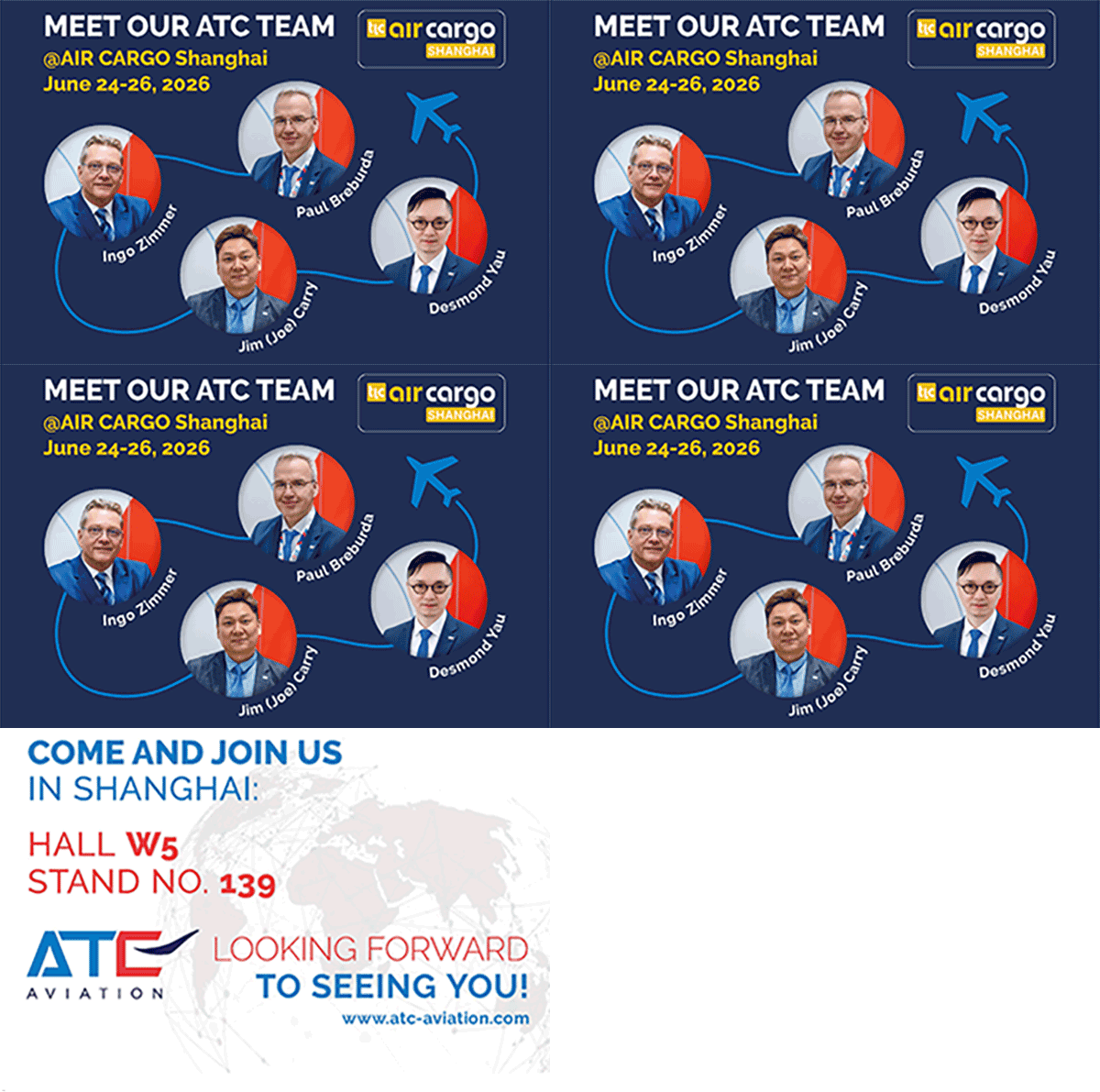
ATC Air Cargo Shanghai Ad


EMO Trans ad
FlyingTypers Logo
#INTHEAIREVERYWHERE
Feed The Children Ad
   Vol. 25  No. 28                                                                          

Wednesday June 3, 2026

linespacer
linkedin
facebook
Instagram
PayCargo Advert

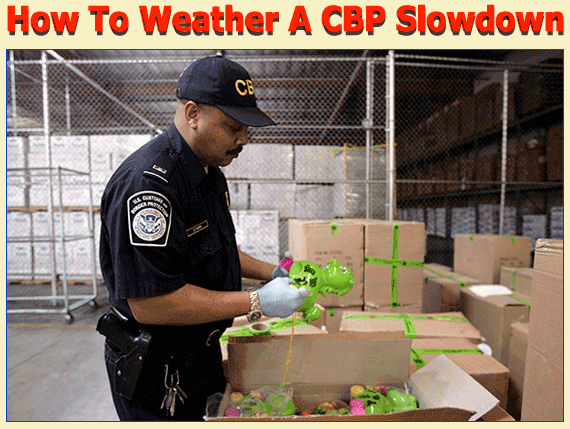
Customs And Border Protection Officer

Markwayne Mullin     In USA the potential cutback of Customs and Border Protection (CBP) officers from airports in sanctuary cities poses a significant threat to the air cargo industry and global trade.

     A recent proposal from Homeland Security leadership, linked to Markwayne Mullin (right), suggests this move as a means to pressure jurisdictions on immigration enforcement.
     The Washington, D.C.-based Airforwarders Association has described these planned cutbacks as a "gut punch," particularly for airports that handle large volumes of international freight.
     Their message is clear: reducing cargo processing capacity at major gateways leads to immediate disruptions in time-sensitive supply chains, not a gradual issue.
     Brandon Fried, Executive Director of the Airforwarders Association, emphasized the critical role of officers at gateways, stating, “There's no clean substitute for officers on the ground at the gateways. You can't reroute a widebody freighter the way you'd reroute a truck.
     “Major airports like LAX, JFK, O'Hare, and SFO are vital due to their established carrier and flight networks, So switching horses midstream isn't really an option on the major lanes.”
     To mitigate potential disruptions, the Airforwarders Association advises members to take proactive measures:
            File entries through ACE before aircraft land to maximize pre-arrival processing by CBP.
            Join the Customs Trade Partnership Against Terrorism (CTPAT) to gain trusted-trader priority during officer shortages. 
            Move clearable freight in-bond to less congested facilities when feasible.

      These steps can help maintain the flow of essential goods and minimize the impact of any changes in CBP operations.
Brandon Fried      Brandon adds, “There's also a funding lever people forget. Under the Reimbursable Services Program, airports and stakeholders can pay for CBP overtime directly.
      “It leaves a bad taste, since we'd be paying twice for a federal function, but the tool is already on the shelf.
      “But mitigation manages the damage.
      “It doesn't fix it.
      “The fix is not pulling officers out of the country's busiest gateways in the first place.
      “You don't make the border more secure or trade more efficient by thinning the line at the airports that move the most freight.
      “That's why we've written to the Secretary and the Commissioner, and why we're building a coalition to oppose this move.”
      Listen up air cargo folks:
      Our industry knows full well that air cargo isn’t a warehouse business.
      It’s a keep-moving business.
      A shipment delayed at clearance doesn’t just wait patiently. It misses connections. It triggers rebooking. It stacks up in terminals that weren’t built for indefinite storage.
      And then every step downstream starts to wobble.
      In the U.S., sanctuary cities move billions in global cargo, day after day.
      If you squeeze processing there, you’re not pinching the edge of the network.
You’re stepping on the main hose.
      And critics are pointing out something that sounds obvious, but matters: where exactly is the freight supposed to go?
      Diverting shipments isn’t like rerouting a rideshare.
      Other airports don’t just have spare space, staff, and equipment waiting around for a sudden surge.
      Plus, even if another airport could take some overflow, you still have the rest of the chain to deal with. Trucking capacity. Warehouse appointments. Delivery windows. Cold chain requirements. Security protocols. Time-critical cargo doesn’t magically become flexible because paperwork got slower.
      That’s why the pushback is getting loud—and not just from freight insiders.
Big trade organizations are stepping in: Airlines for America, the U.S. Chamber of Commerce, the National Retail Federation. Different missions, same message: CBP cargo operations are part of national economic resilience.
      Telling it like it is:  
      The CBP proposal is framed as leverage on immigration policies.
      But CBP at airports isn’t only about people.
       Cargo operations have their own legal and operational necessity.
      The air cargo industry is essentially saying: whatever your policy goal is, don’t break the mechanism that keeps trade moving.
      Because the costs don’t stay local. A delay in Newark can ripple to a manufacturer inland.
      A backlog at LAX can slow retail restocks across multiple states.
      And time-sensitive shipments—pharmaceuticals, critical components, perishables—can’t afford to negotiate with bureaucracy.
      So where does that leave us?
      In the middle of a high-stakes argument where one side sees a pressure tactic, and the other sees a nationwide supply chain risk.
      And the reason people are alarmed is simple: this isn’t a slow-moving policy change.
      If staffing drops at these hubs, the disruption shows up fast.
      We’ll be watching where the lobbying and the decision-making go from here.       But for now, the air cargo message is clear: don’t turn customs staffing into a bargaining chip, because the supply chain doesn’t have an easy detour.
GDA/SSA


Kale Advert

Demetrius Jones, Renee Villanueva, Tammy James, Sven Frigger, Stacie Countryman, Nicole Girouard, Lauren Allen

     EMO Trans has been implementing customized global logistics solutions for over 50 years.
     With over 100 EMO Trans offices and EMO Trans headquarters in 25 countries and 250+ network offices in 120 countries covering 6 continents, the company is known and admired as nimble, yet stable, and filled with people who are proud to deliver the personalized service of a privately-held company with the robust infrastructure of a multi-national leader.
     Today we’re getting into a part of freight forwarding most people never see until something goes wrong: compliance. And not the boring checkbox version. I mean the real-world stuff that can stop freight at the border, ground a shipment, or put a company at risk if it’s handled carelessly.
      We note that the all-important forwarder function of compliance is always on the mind of our industry and of course is headlining conversations at trade shows and conferences.
     So here we share a conversation with Sven Frigger, Vice President Compliance at EMO Trans. What makes his team really interesting is that, for the last few years, it’s been an all-women group—six gals and a guy leading the way to compliance at one of the most dynamic and respected, fastest growing logistics operations in the world, handling a seriously complex workload across air and ocean.


What are the biggest compliance challenges currently facing the global logistics industry?
     
Shifting regulations and volatile tariffs, combined with ongoing geopolitical disruptions, are creating a highly unstable global trade environment. Governments are frequently updating trade policies, sanctions, and duty structures, forcing companies to continuously reassess classification, origin, and cost impacts. At the same time, conflicts and regional tensions are disrupting key shipping lanes and airspace, leading to rerouting, longer transit times, and increased fuel costs. These changes not only drive up transportation expenses but can also alter compliance requirements mid-shipment, making it more difficult for logistics providers to maintain accuracy, control costs, and ensure regulatory compliance in real time.
 
What are common compliance mistakes that companies make, and what are the repercussions they face?
     Companies often make compliance-impacting mistakes such as misclassification of goods, vague or incomplete cargo descriptions, missing or inaccurate documentation, and reliance on untrained or underinformed staff. These errors can lead to incorrect duty payments, delays in customs clearance, shipment holds, or even regulatory penalties and fines. In more serious cases, repeated violations may trigger audits, loss of trusted trader status, or increased scrutiny from authorities, ultimately disrupting operations and damaging both financial performance and business relationships.
 
What are the most common errors you see in export filings?
     Common AES filing errors typically include incorrect or incomplete commodity descriptions, misclassification of goods, missing or inaccurate export values, inaccurate party information such as ultimate consignee details. Other frequent mistakes involve failing to report required licenses or using incorrect exemption codes. Late or missing filings can also create compliance issues which could result in fines. 
 
What are some best practices EMO has put in place to ensure minimal regulatory risks?
     Best practices in place include a combination of audits, along with routine daily, weekly, and monthly reviews of system-generated reports to proactively identify and correct errors. Branch and internal audits are conducted on a regular, risk-based schedule to ensure ongoing compliance with regulatory requirements and company policies. Internal audits are typically performed annually or more frequently depending on operational risk, while branch-level reviews may occur periodically throughout the year. In addition, external Quality Management System (QMS) audits aligned with standards such as International Organization for Standardization ISO requirements (e.g., ISO 9001) are conducted at defined intervals by certified third-party auditors. Together, these regulatory, internal, and external audits help ensure consistent adherence to compliance standards, identify gaps, and drive continuous improvement across operations.
     In addition, employees are empowered with the tools, resources, and training they need—both required and elective—to support accuracy, accountability, and continuous improvement across operations. We maintain a structured training and certification process that includes ongoing, job-specific training tailored to individual roles, along with mandatory annual regulatory and security training to ensure compliance with industry requirements. In addition, personnel are encouraged to pursue further professional development by enrolling in optional courses of choice that align with their responsibilities and support their continued growth and effectiveness in their roles.
     The corporate compliance team is also readily accessible, serving as a resource for both internal staff and external clients to provide guidance, answer questions, and ensure adherence to regulatory requirements.

How is automation improving compliance accuracy?
     Automation streamlines data entry, standardizes processes, and reduces reliance on manual inputs that are prone to error. While automation continues to evolve, it already helps minimize typographical mistakes and oversights common in manual processes, while also reducing the time required to complete tasks—ultimately lowering frustration among operators and improving overall efficiency. In addition, automation supports more accurate sustainability tracking in transportation by enabling better calculation and reporting of emissions and environmental impact, helping organizations align compliance efforts with growing environmental and regulatory expectations..
 
How does strong compliance benedit EMO customers?
     Strong compliance directly benefits customers by ensuring their shipments move efficiently, accurately, and in full alignment with regulatory requirements. It reduces the risk of delays, penalties, or disruptions by getting classifications, documentation, and filings right the first time. In addition, it provides customers with confidence that their supply chain is being managed responsibly and transparently, protecting their reputation while supporting consistent service, predictable costs, and smoother overall operations. Many of our customers have long-standing relationships with us and benefit from direct access to members of the compliance team, who stay current with today’s rapidly changing environment through ongoing training, conferences, webinars, and other professional development—sharing updates and relevant details with clients to keep them informed and ahead of regulatory changes.
      Compliance plays a critical role in shaping a company’s reputation by demonstrating integrity, reliability, and a commitment to doing business the right way. Strong compliance practices build trust with clients, partners, and regulators, while reducing risk and ensuring consistent, high-quality operations.
Reprinted with permission


Chuckles for June 3, 2026

Ramanathan Rajamani

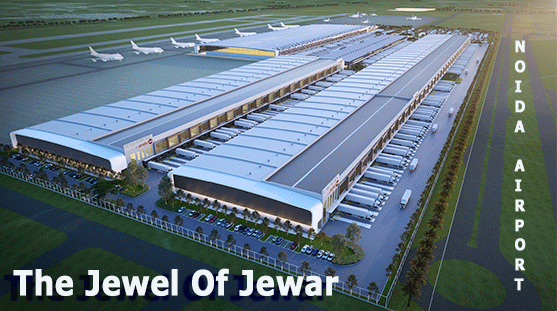
     Come June 15, 2026, the roar of jet engines will signal more than just the birth of a new airport. The commencement of commercial operations at Noida International Airport (NIA) in Jewar (Delhi and the Indian National Capital Region’s second international airport) will mark the opening of a strategic sluice gate for global trade. While the passenger terminals will buzz with travelers, a more quiet, tectonic shift is occurring at the airport’s northern flank: the rise of a digitally integrated, multimodal cargo powerhouse.
     At the heart of this ambition is AISATS (Air India SATS Airport Services), whose Multi-Modal Cargo Hub (MMCH) is designed to be the primary engine of NIA’s promised ₹1 lakh crore annual economic multiplier. In an exclusive dialogue,  Ramanathan Rajamani, CEO of AISATS, explains why Jewar is not just another pin on the aviation map, but a fundamental redesign of Indian logistics.
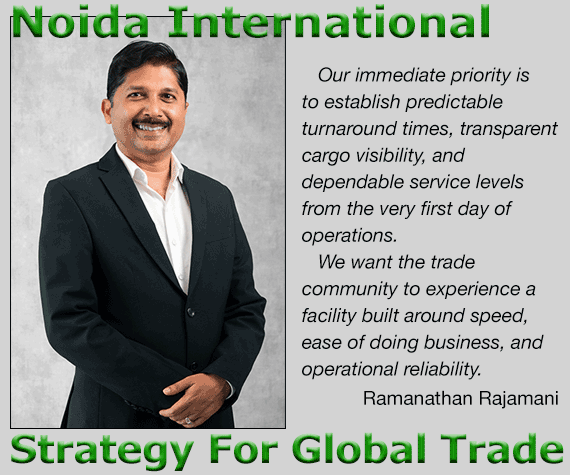
     For freight forwarders and shippers, the “Day 1” experience at NIA is built around a philosophy of immediate reliability. The Integrated Cargo Terminal (ICT) is prepared to handle an initial 255,000 metric tonnes of cargo annually, with a blueprint that allows for seamless expansion as the region’s manufacturing muscle grows. “Our immediate priority is to establish predictable turnaround times, transparent cargo visibility, and dependable service levels from the very first day of operations," says  Rajamani. "We want the trade community to experience a facility built around speed, ease of doing business, and operational reliability."
     The traditional Indian cargo model has long been plagued by fragmentation—warehousing, customs, and terminal movement often sit in disjointed pockets, leading to "logistics friction." AISATS is countering this with the Integrated Warehousing & Logistics Zone (IWLZ), a first-of-its-kind development in the country. “At Noida, our IWLZ and Integrated Cargo Terminal have been planned as one connected ecosystem,” Rajamani explains. “This means cargo can move seamlessly from storage to build-up, customs processing, and airline handover within a single zone. The result is lower truck turnaround time, fewer hand-offs, and significantly reduced dwell time.”

AISATS Noida Terminal

     The hub’s efficiency is underpinned by a “tech-first” approach. AISATS has deployed a suite of digital tools including truck slotting systems, digitally enabled gate access, and real-time predictive dashboards. This ensures that the heavy traffic expected from the Yamuna Expressway doesn't result in the bottlenecks seen at legacy hubs.
     Beyond the tarmac, the strategy involves "bonded trucking" partnerships, such as the MoU with Continental Carriers. This allows exporters in distant manufacturing clusters to complete customs processes locally and use NIA as a streamlined exit point. “Airports today are no longer standalone terminals; they are networked gateways,” notes Rajamani. “This will offer exporters a cost-effective and streamlined gateway to accelerate the movement of cargo by airlines operating from Noida International Airport.”
     The region surrounding Jewar is rapidly becoming a hub for electronics, textiles, and e-commerce. A recent collaboration between AISATS and Samsung SDS for electronics exports underscores this potential. However, high-value sectors like pharmaceuticals require more than just speed; they require precision.
     To meet these demands, AISATS has integrated a dedicated "Coolport" with temperature-zoned storage and specialized truck docking zones. “The objective is to minimize exposure risk at every touchpoint, from truck arrival to aircraft loading,” says Rajamani. “For pharma and perishables exporters, this creates a highly reliable cold-chain environment aligned with international quality expectations.”
     As global manufacturers face increasing pressure to lower their Scope 3 emissions, NIA’s net-zero vision becomes a significant draw. AISATS is mirroring this commitment by adopting electric ground support equipment (GSE) and paperless digital processes. “Sustainability is increasingly a commercial differentiator in global supply chains,” Rajamani asserts. “At AISATS, sustainability is not a standalone initiative but an integral part of the way we plan and operate our business.”
     While belly cargo from launch partners like IndiGo and Akasa Air will drive initial volumes, the long-term play involves the Dedicated Freight Corridor (DFC). The integration of air, road, and eventually rail, positions Jewar to compete with the world's most efficient logistics zones.
     As Uttar Pradesh attracts billions in investment for data centers and industrial townships, the AISATS MMCH stands ready as the gateway. “The combination of road, rail, and air integration around Noida will create one of the most efficient logistics zones in the country,” concludes Rajamani. “Our long-term planning fully recognizes the strategic importance of seamless air-to-rail cargo movement.”
     With trial operations underway and the June 15 launch date looming, the message from AISATS is clear: The Jewar gateway is open, and it is built for the future of Indian exports.
Tirthankar Ghosh


FlyingTypers Ad
If You Missed Any Of The Previous 3 Issues Of FlyingTypers
Access complete issue by clicking on issue icon or
Access specific articles by clicking on article title
FT051826
Vol. 25 No. 25
Lady Puts A Slammer On CNS SFO
Chuckles for My 18, 2026
AS Alaska Launches Seattle/London
Sunrise For Riyadh Cargo
FT051926
Vol. 25 No. 26
Fried Keynotes CNS Partnership
Rajni Patwardhan Rebranding Kale
Bangaranga Rhythms At SEEFF

FT052826
Vol. 25 No. 27
Atlanta Port Day Report
Chuckles for May 28, 2026
PayCargo Ups Fintech Innovation Down Under
Pfeil At ATC Keeping A Step Ahead

Publisher-Geoffrey Arend • Managing Editor-Flossie Arend • Editor Emeritus-Richard Malkin
Senior Contributing Editor/Special Commentaries-Marco Sorgetti • Special Commentaries Editor-Bob Rogers
Special Assignments-Sabiha Arend, Emily Arend
• Film Editor-Ralph Arend • Photo Editor-Anthony Atamanuik

Send comments and news to geoffrey@aircargonews.co
Opinions and comments expressed herein do not necessarily reflect the views of the publisher but remain solely those of the author(s).
FlyingTypers reserves the right to edit all submissions for length and content. All photos and written material submitted to this publication become the property of FlyingTypers Media.
Copyright ©2026 FTMedia, Inc. All Rights Reserved.
More@ www.aircargonews.com

recycle100% Green