 |
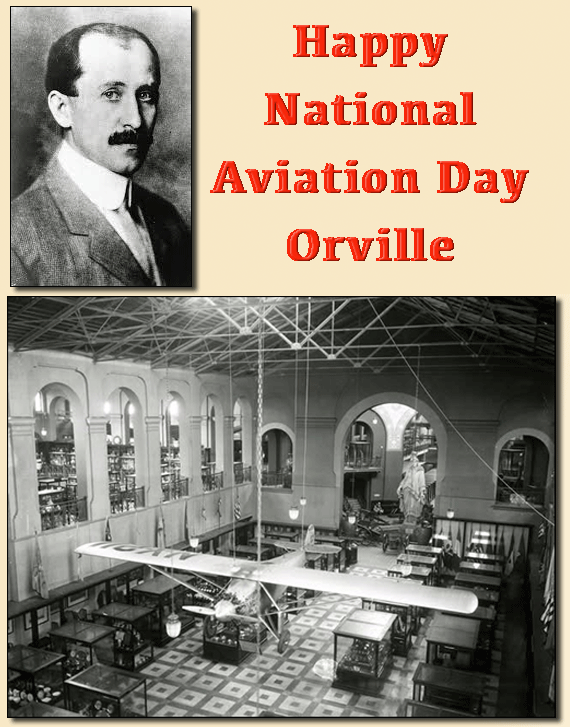
Every year on August 19th, the U.S. pauses to mark the story of flight and how everything changed because humans figured out how to leave the ground on purpose.
The date isn’t just a nice spot on the calendar. It’s Orville Wright’s birthday, officially set aside back in 1939 by proclamation of President Franklin D. Roosevelt.
So here’s what we couldn’t stop thinking about this year.
 If any institution should give Orville Wright a clear, bright moment on National Aviation Day . . . shouldn’t it be the National Air and Space Museum (NASM) in Washington, D.C.? If any institution should give Orville Wright a clear, bright moment on National Aviation Day . . . shouldn’t it be the National Air and Space Museum (NASM) in Washington, D.C.?
Yet, August 19th came and went without a real standalone marker from the museum.
Instead, most of the spotlight is pointed at something huge and genuinely worth celebrating: the fiftieth anniversary of the Smithsonian National Mall building, rolling through the summer of 2026, with major events already underway.
To be fair, fifty years is significant. A museum like that doesn’t just “turn fifty.” It survives, grows, becomes part of how a nation tells its story. Still, the timing feels a little strange, because the museum’s identity is built on the exact kind of turning point that National Aviation Day is supposed to honor.
Before it was a modern landmark on the Mall, the Smithsonian’s aviation story was scrappier. Early displays lived in the old Arts and Industries Building, where flight was presented in a way that would feel almost improvised today. Models under glass. Aircraft suspended overhead. Not a destination yet, just a growing collection and a public that couldn’t get enough of this brand-new idea that people could actually fly.
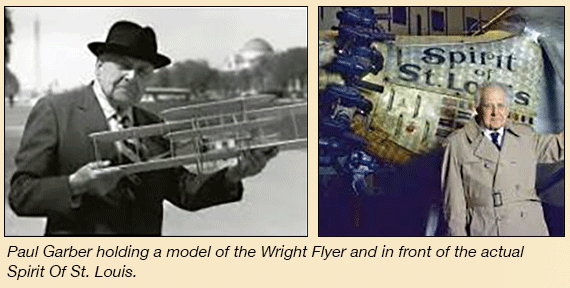 |
This is where one of the most important names enters the picture: Paul Garber.
Garber was Smithsonian aviation curator for 72 years from 1920 until 1992, and from everything you can tell, he had this stubborn, purposeful drive.
The Paul E. Garber Facility that houses a collection of aircraft at Dulles Airport is named for this legendary character.
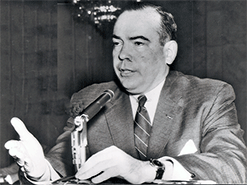 I recall, when I delivered the eulogy for my friend (pictured below), Edward Ansel Talbert in the Arlington Chapel in 1987 . . . there was Paul Garber, unannounced, to honor Ansel, the great New York Herald Tribune journalist who had joined us (Air Cargo News) in 1981, delivering Special Commentaries. I recall, when I delivered the eulogy for my friend (pictured below), Edward Ansel Talbert in the Arlington Chapel in 1987 . . . there was Paul Garber, unannounced, to honor Ansel, the great New York Herald Tribune journalist who had joined us (Air Cargo News) in 1981, delivering Special Commentaries.
When the services ended, I spoke to Mr. Garber of Ed Talbert’s work with Jimmy Doolittle and Operation Ultra in England during WWII. I shared that the General responded to my call for help in interring Ansel at Arlington National Cemetery. He tasked his son to work with my wife Sabiha, and both then saw to it that Ed Talbert received a full military service, 21-gun salute and all, with final internment at Arlington National Cemetery.
“I know,” Paul Garber smiled.
“I spoke to the General.”
I invited Mr. Garber to join a group of writers after the funeral for a Talbert Memorial get together at the National Press Club.
He politely declined saying: “I have to get back.”
And he was gone.
Paul Garber, as a curator, wasn’t collecting objects for the sake of collecting. He was trying to save proof. Proof that the impossible had been done, and that it mattered enough to preserve carefully, before it got lost to time or treated like a temporary thrill.
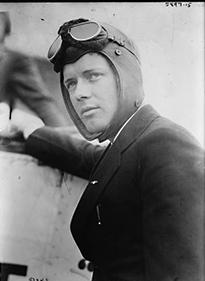 One of Garber’s big wins was persuading Charles Lindbergh to donate the ‘Spirit of St. Louis’. That wasn’t just another airplane to hang up. It arrived with gravity. With fame. With a kind of cultural pull that told the world, this is where aviation history is going to live. Inevitably, that move got the ball rolling and nudged other donors to think the same way. One of Garber’s big wins was persuading Charles Lindbergh to donate the ‘Spirit of St. Louis’. That wasn’t just another airplane to hang up. It arrived with gravity. With fame. With a kind of cultural pull that told the world, this is where aviation history is going to live. Inevitably, that move got the ball rolling and nudged other donors to think the same way.
After Orville Wright died in 1948, the ‘Wright Flyer’ from Kitty Hawk was left to the Smithsonian.
For years, visitors could walk into that older building and see two defining symbols overhead: the ‘Wright Flyer’ and the ‘Spirit of St. Louis’.
One aircraft representing the birth of powered flight. The other representing a world that suddenly felt smaller, because air travel could stitch it together.
The people came in waves. It got so busy that visitor counts became a serious operation. Not just aviation die-hards, either. Hundreds of thousands of people a year, crowding into a space that was never built for that kind of demand. That popularity evolved into the next step.
On July 1, 1976, the National Air and Space Museum (NASM) opened, and it quickly became one of the Smithsonian’s signature institutions. Now, in the summer of 2026, it’s celebrating fifty years while also emerging from what’s basically a rebirth: a roughly one-billion-dollar renovation, redesigned galleries, major spaces reopening around that same July 1 milestone.
Today, between the National Mall museum and the Udvar-Hazy Center in Chantilly, Virginia, you’re looking at around three million visitors a year. It’s one of the most visited museums in the country, and it’s a global reference point for how aviation and space history gets collected and explained.
A lot of that authority comes from the people behind the scenes, too. Over the decades the museum has been tied to major voices who helped shape how the public understands aviation.
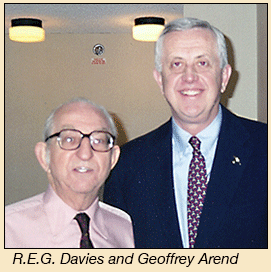 R.E.G. Davies is one of the great examples. Ron’s output through Smithsonian channels was enormous, and his collaborations with artist Mike Machat produced great airline histories. R.E.G. Davies is one of the great examples. Ron’s output through Smithsonian channels was enormous, and his collaborations with artist Mike Machat produced great airline histories.
Machat’s exquisite art and Ron’s words gave people a way to see aviation’s golden age, to feel the branding and the romance and the look of it, from Pan Am to Delta to TWA to Lufthansa and beyond.
Today at NASM, there are curators and historians like Tom Crouch, who helped create that recognizable “museum voice” many of us still encounter in Smithsonian books, catalogs, and the museum shop. That voice matters. It’s part of how a museum becomes not just a building with objects, but a storyteller with credibility.
So again, if you will allow, here’s our gentle but very real question. How does an institution so deeply tied to Orville Wright’s legacy glide past National Aviation Day without a clear moment of recognition? A 50th anniversary can be the headline, sure. But National Aviation Day doesn’t have to compete with it. It can live inside it. A short tribute. A focused acknowledgment. Something that simply says, out loud, we remember why this all started.
Because the Smithsonian’s aviation story isn’t abstract. It’s made of people and decisions. It’s Garber pushing to preserve what mattered before everyone agreed it mattered. It’s Lindbergh trusting the institution with his most famous aircraft. It’s Orville Wright’s legacy being literally placed into the museum’s care. That’s the foundation.
Hey lover of aviation, wherever you are today, you can do the small thing that still counts: take a birthday moment for Orville Wright, one of the minds behind the first powered flight.
While you’re there, tip your hat to Lindbergh and to Paul Garber, too, because without persistence like that, history isn’t an illusion, it is a fact.
Maybe that’s the bigger point. What we choose to honor, and when we choose to honor it, shapes the history we pass on.
That’s also why we have been thinking about the work ahead.
A new project called Air Cargo Chronicles is launching in September, right in these pages built from decades of watching the industry up close.
If we’re going to celebrate air cargo history honestly, we have to make room for the people, routes, networks, and operations that truly got it off the ground, including defining efforts like the Berlin Airlift.
History deserves clarity. It deserves names. It deserves the truth.
I’ll end this with the question that’s been hanging in the air for me: has anyone seen my old friends Orville, Charles, and Paul lately?
If you find them, don’t just glance their way.
Say their names. Remember what they built.
Geoffrey Arend |










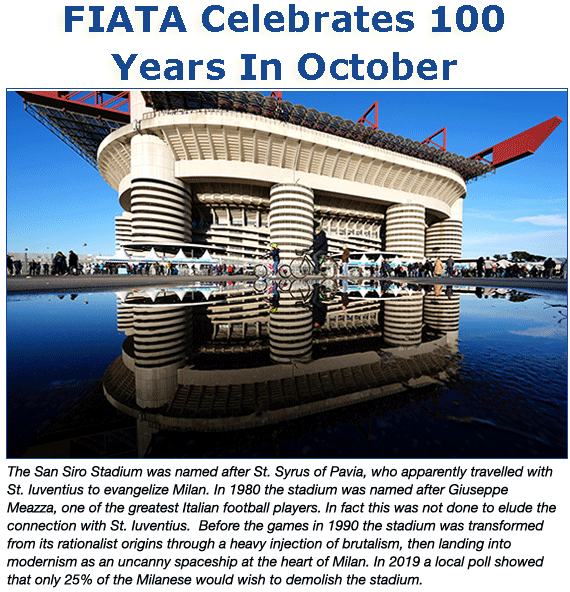
 FIATA President Professor Doctor Thomas Sim has been clear about the pressures: geopolitical uncertainty reshaping routes, technology transforming how freight is managed and tracked, and sustainability moving from a promise on paper to something that has to function operationally.
 FIATA’s Director General, Doctor Stéphane Graber, has been emphasizing a very practical answer: trusted information flows.
 The portal side of it is meant to give customers real visibility. You can track shipments with an AWB reference and connect that to Menzies’ global cargo network. It’s not just about paying; it’s about seeing what’s going on without having to chase down updates Menzies says the adoption has been strong. Since launching in 2023, MACH has rolled out across 49 airports, and it’s already handled more than 1.6 million air waybills. That’s not a pilot program anymore. That’s a system doing real work.
 Eduardo Del Riego, (left) PayCargo’s Global CEO, put it in very practical terms: in air cargo, speed and certainty are everything, and payments should never be the reason a shipment gets stuck. This partnership makes it simpler to pay and faster to release cargo.
 100%
Green
100%
Green