 |
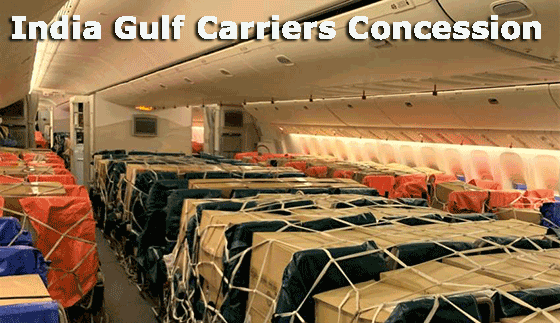
There's a familiar feeling in the global air cargo business right now, though it comes with a pretty smart, modern update. India's Ministry of Civil Aviation recently made a key change, giving Gulf airlines—big names like Emirates, Kuwait Airways, and Jazeera Airways—special approval to use their passenger planes just for cargo. What's really notable is they can actually load freight right into the passenger cabins. Remember "preighters" being a lifeline when the pandemic hit hard, but this time around, the move addresses a whole new kind of problem: a serious lack of cargo space, largely due to the growing geopolitical tensions in West Asia.
This whole situation, often referred to as the 'The West Asian Squeeze,' really comes down to how the ongoing crisis in Iran and wider West Asia has completely shifted air travel for the subcontinent. Because of airspace closures and strict rules over places like Iran, Iraq and Jordan, flights heading to Europe and North America now have to take much longer, fuel-intensive routes. For both Indian and international airlines, these stretched-out journeys mean their planes aren't used as efficiently, and there's a lot less space in the cargo holds on those key trade routes.
At the same time, India's export businesses are really going strong, with steady demand for high-value, time-sensitive goods. So, by letting Gulf carriers use their passenger planes, which might otherwise sit idle, as temporary cargo aircraft, New Delhi is essentially making a practical regulatory move to bring some much-needed capacity into a very tight logistics market. It is no surprise that the focus is on Gulf airlines; these carriers, both because of where they are and how they operate, act as the main hubs connecting Indian manufacturers to the big consumer markets out West.
For Indian exporters dealing with tight supply chain deadlines, this new policy offers a real boost. Industries that are growing fast—pharmaceuticals, electronics, precision engineering, and anything perishable—are incredibly vulnerable to any hiccups in transit. Imagine a critical shipment of medicine or high-tech microchips getting delayed by just 48 hours because of a scheduling change—the financial fallout could be huge. So, bringing in all this extra cargo space in passenger cabins from Gulf carriers means a more reliable schedule right away, which should also help calm down the cargo rate swings we often see during regional troubles.
It is important to note that moving cargo from the highly efficient, automated lower hold up into the passenger cabin’s carpeted aisles isn't without its challenges for both ground crews and airlines.
India’s Directorate General of Civil Aviation (DGCA) has put in place some very strict safety rules for these flights: First, there are strict bans on certain goods. Dangerous items, especially lithium-ion batteries and oxygen tanks, are a ‘No, No’ on the upper deck. Second, everything needs rigorous securing. Cargo has to be carefully fastened down in specific spots—think overhead bins, closets, or even strapped into seats using special, heavy-duty bindings, all to handle any turbulence during the flight. And finally, unlike dedicated freighters with their automatic fire suppression systems, these passenger-to-freight flights must have a mandatory number of crew members onboard in the cabin. Their job is to constantly watch the space and be ready to handle any emergencies as they happen.
While this policy definitely helps clear up some immediate snags in the supply chain, it also changes things quite a bit for competition. Indian carriers, many of whom are really pushing to grow their international routes and putting money into their own dedicated cargo planes, will now find themselves up against strong competition at home.
The huge activity of the Gulf carriers, their sophisticated hub-and-spoke network and the very efficient freight network could support a massive volume of business very rapidly. Yet, given the omnipresent Indian uncertainty, reinforced by the Ministry of Civil Aviation vigilance on the geopolitical gamble, the primary task for India is always to support the economy stability. India demonstrates with its decision to adopt a liberal regulation approach rather than leaving protectionism as the only asset, that it is now the time for flexible policies not only in emergency, but as the insurance of a reliable supply chain for the future.
Tirthankar Ghosh |








 100%
Green
100%
Green