 |
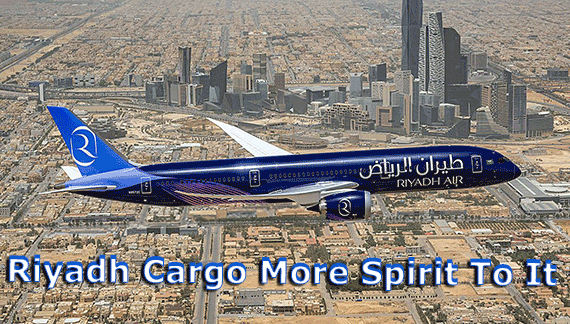
Picture this. It’s 2026, and a brand-new airline is taking off from Saudi Arabia with a goal that’s bigger than just flying people from one city to another. It also wants to change how the world moves goods, and it wants to do it from Riyadh.
And when you hear “Riyadh,” it almost has a rhythm to it—which is apt, because the word traces back to gardens and greenery.
But in the planning rooms, Riyadh means something else now: a capital with serious aviation ambition.
Today, we’re not focusing on the cabin design or the hype around a massive aircraft order.
We’re going underneath the passenger schedule, into the cargo hold, where the real pressure lives. Because this airline isn’t treating freight as a quiet side hustle.
Alongside Riyadh Air, there’s a dedicated freight identity: Riyadh Cargo, and that naming choice matters—because in logistics, nobody wants “also, we do cargo.” They want a clear product, clear responsibility, and clear systems.
So let’s set the scene in our story.
The first chapter isn’t some grand, instant worldwide network. It’s the early build—choosing partners, choosing lanes, and proving the operation in the real world, shipment by shipment.
That’s where the recent move comes in: appointing General Sales and Service Agents (GSSAs) in three key markets—Egypt, India, and the UAE. Those aren’t random dots on a map. They sit right next to some of the world’s busiest trade corridors linking Asia, the Middle East, Africa, and Europe.
 |
“We’re building our service network with local partners who understand their markets,” declared Pravin Singh, VP of Cargo at Riyadh Air and Head of Riyadh Cargo.
What we liked immediately about Pravin were his first words upon assuming his position last year:
“The prospect of creating a new cargo business with a blank canvas, using technology and innovation as primary tools is hugely exciting.” Right away, Riyadh Cargo—with more spirit to it—felt like a breath of fresh air.
For India, Riyadh is working with Air Logistics Group India. In the UAE, it is Cargo Partners International operating under dnata Cargo.
For Egypt, the GSSA designate is M&C Aviation Group, and the list goes on and will be expanded.
“Sensible” is the way Riyadh describes the rollout: phased activation.
Not flipping a switch everywhere at once.
More like, “We’ll turn each market on when it’s ready—when the network can actually support it.”
That’s a very different tone from the usual launch-driven bravado.
Because cargo is unforgiving.
If passenger service disappoints, people complain.
If cargo service disappoints, supply chains snap.
A missing pallet doesn’t just annoy someone—it can shut down a production line or ruin a shipment of fresh goods.
As we go to Press, Riyadh Air is serving London Heathrow (LHR)with daily flights that launched today June 10th and bookings are available on the website and mobile app.
Dubai International (DXB): Daily service bookings are open with June 18th launch date for a second daily service in the Riyadh schedule.
Cairo, Madrid, and Manchester expansion hubs are set to follow quickly through the rest of the summer. |
Examining the markets that Riyadh Cargo is building in reveals a strategy.
India delivers scale and consistent demand. The UAE brings connectivity and forwarder ecosystems. Egypt opens doors across key lanes and adds growth potential, including more direct routing that shippers love because it cuts time and handoffs.
Now, let’s talk about the character at the center of this cargo storyline: leadership.
Mr. Singh, describing the cargo opportunity as a blank canvas, also notes technology and innovation first—not as a bolt-on later.
That’s a big statement, because legacy cargo systems can be… let’s just say, complicated.
He keeps coming back to this idea: global reach, local execution. Meaning you can dream about worldwide cargo flows all you want, but if the handling, documentation, and communication aren’t sharp on the ground in each market, you’re dead in the water.
So what does Riyadh Cargo actually move right now?
One of the early proving routes is Riyadh to London Heathrow.
Heathrow isn’t a friendly practice field. It’s high-volume, high-expectation, and operationally intense.
The goods Riyadh Cargo has already carried on that lane tell you what kind of performance they’re chasing: garments and textiles, fresh flowers, seafood, tea, and coffee.
That’s not just a random list. Flowers and seafood are a timer—if you’re late, the product loses value fast. And it’s not enough to just deliver.
“Shippers want trackability, forwarders want predictability, everyone wants fewer surprises—and when disruptions happen, they want visibility and fast answers.”
Which brings us to the phrase used by Riyadh Cargo for this early stage: “a pathway to perfect.”
Not perfect on day one.
More like: start operating, learn from real shipments, tighten the process, then scale.
That’s a mature approach, because reliability doesn’t come from announcements. It comes from repetition—doing the same thing correctly again and again until it’s a system, not a heroic effort.
Now, the backbone of this story is digital capability.
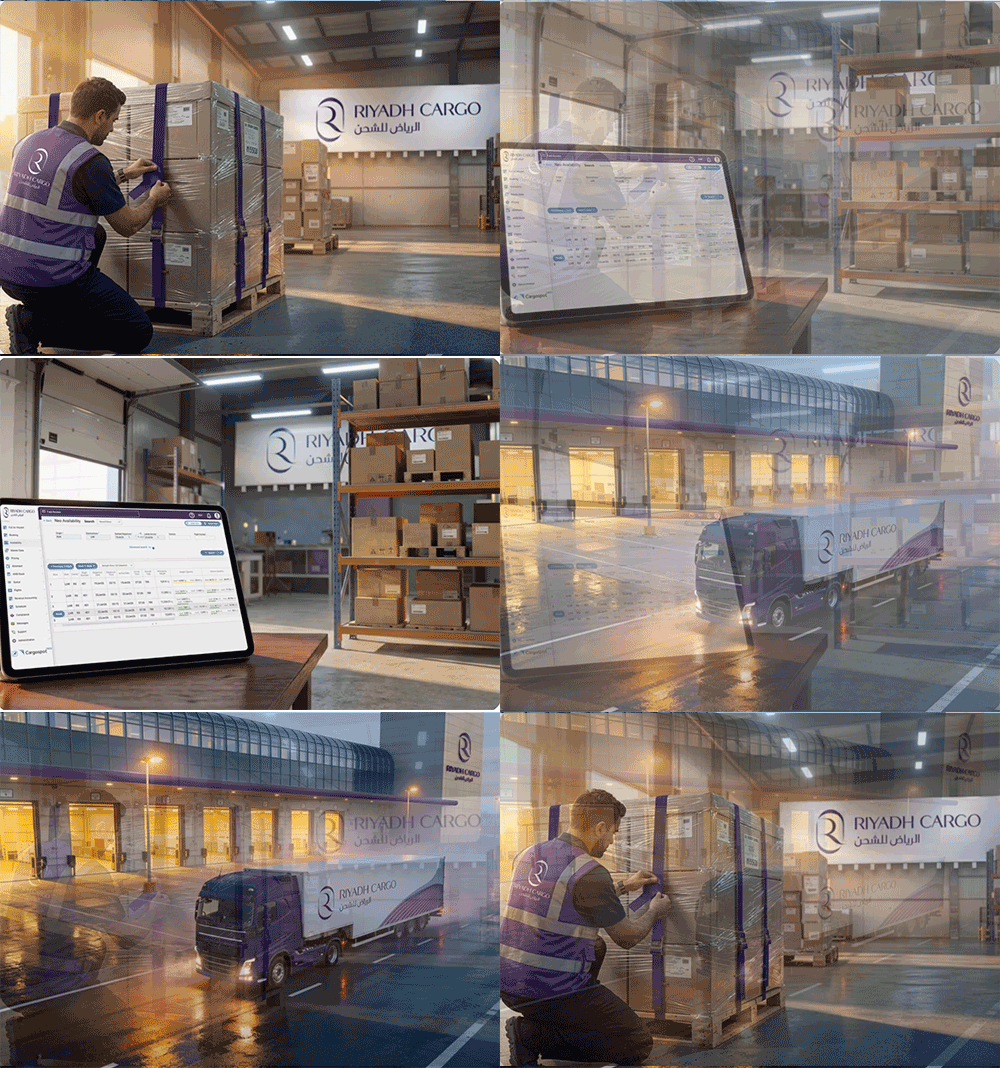
Riyadh Cargo wants to be tech-led from day one, with dedicated cargo management systems and centralized control over airwaybills. That’s one of those “boring” details that becomes priceless when volumes rise or the network gets stressed.
So, Riyadh Cargo is partnering with CHAMP’s Cargospot neo Platform, designed to run cargo operations end-to-end. And digitization isn’t only about software dashboards. The carrier is also investing in digitally tracked ULDs—those cargo containers and pallets that constantly go missing across the industry.
For that, they’re working with Unilode.
It signals something important: equipment visibility isn’t being treated as a nice-to-have. It’s being treated as service reliability—and even sustainability—because fewer lost units means fewer inefficiencies.
But you can’t digitize your way out of bad ground handling. So on the ground, Riyadh Cargo is working with SATS in Saudi Arabia.
Riyadh is the primary hub, with services extending across key airports like King Khalid International in Riyadh, King Fahd International in Dammam, and King Abdulaziz International in Jeddah.
Outside Saudi Arabia, Riyadh Air has lined up additional partners too. Worldwide Flight Services at London Heathrow is a major one.
They’ve also secured partnerships in Pakistan, Sri Lanka, the Maldives, Bangladesh, and the UK—supporting both online and offline sales, including in Manchester.
So if we zoom out, what’s the bigger reason Saudi Arabia is putting this much energy into cargo right now? Vision 2030.
The broader goal is to diversify the economy beyond oil by creating sectors that compound—logistics being one of the strongest examples.
Because if you build a credible cargo hub, trade follows. And when trade follows, you start attracting warehousing, manufacturing, services, and jobs. It becomes an ecosystem, not just an airline.
Riyadh Air’s overall growth plan is huge—building toward a major fleet and a network that aims for more than 100 destinations by 2030.
No doubt you’ll hear big economic expectations around it too: major non-oil GDP contribution and hundreds of thousands of jobs tied directly and indirectly to the airline’s expansion.
 |
Here’s a key point not to be forgotten: cargo isn’t a decoration in the big picture.
Cargo helps make the network work financially by supporting route economics year-round.
Air cargo makes the hub valuable not only to tourists and business travelers, but to global supply chains that run every day.
Also, a separate cargo identity—Riyadh Cargo—creates a clear signal to forwarders and shippers: this is a focused operation, with leadership, systems, and accountability.
In logistics, that clarity can be the difference between an “interesting press story” and a “trusted partner.”
So what is the takeaway as we wrap up?
Riyadh wants to become a connector city, not just a destination.
The cargo business is ramping up in a controlled way—prove it on live lanes like Riyadh–London, then expand without losing the basics.
The strategy leans heavily on digital foundations: cargo management platforms, centralized data, and trackable ULDs.
It’s tied tightly to a national objective—making Saudi Arabia a global aviation and logistics hub before the decade is over.
And the real tension in this story—the part everyone will be watching—comes down to one question: can Riyadh Cargo scale fast without letting service quality wobble?
For now, the signal is clear. Riyadh Air wants cargo in its identity from the start, and Riyadh Cargo is being built as a tech-forward engine to turn big national ambitions into day-to-day operational reality. More power to them.
Geoffrey Arend |







 100%
Green
100%
Green