|
USER, the Union of Shipping Companies in Romania is a professional organization, established in 1993, which brings together companies with activities covering all modes of transport and related services, including intermodal transport operators, logistics operators and customs brokers. USER has 214 member companies.
May 18-20, USER organized and hosted the Congress of the Association of South-Eastern European Freight Forwarders (SEEFF) & FIATA REU Field Meeting 2026 Congress, a European-wide event, under the slogan "United for Regional Progress in Logistics", bringing together the leaders of associations and companies in the field from 22 countries in Europe and Asia, as well as the top management of FIATA (International Federation of Freight Forwarders Associations).
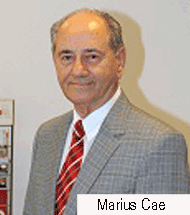
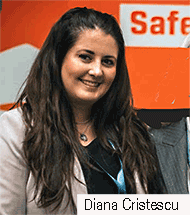
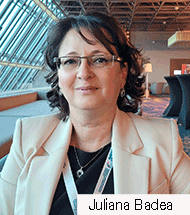
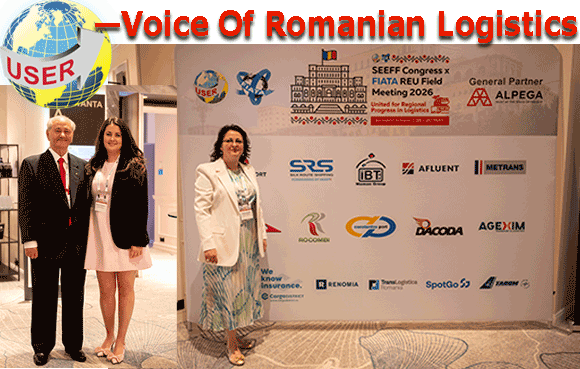
During that meeting FT had the opportunity to conduct a three-way interview with (photo left) Marius Cae, President, with Iuliana Badea, Secretary General. and(photo right) Diana Cristescu, Project Manager of USER.
FT: Congratulations are due for your perfect organization of your conference. Was it a long preparation? How many people worked in this effort in your organization?
 USER: Thank you very much for your appreciation. Organizing the SEEFF x FIATA REU Field Meeting 2026 – The European Freight Forwarders Congress was a major responsibility and, at the same time, a great honour for USER – the Romanian Freight Forwarders Association. USER: Thank you very much for your appreciation. Organizing the SEEFF x FIATA REU Field Meeting 2026 – The European Freight Forwarders Congress was a major responsibility and, at the same time, a great honour for USER – the Romanian Freight Forwarders Association.
The preparation process started more than one year in advance. Hosting, for the first time in Romania, an event that combined both the SEEFF Congress and the FIATA Region Europe Field Meeting required extensive coordination at both national and international level.
Although USER is not a large organization, our entire team was actively involved in the preparation of the congress, together with external collaborators, partners, volunteers and service providers.
Beyond the operational aspects, a significant amount of work was dedicated to building the conference concept, attracting international speakers and sponsors, coordinating with FIATA and SEEFF partners and creating a valuable networking platform for the logistics community.
For us, this event was not only about logistics and organization; it was about representing Romania and the Romanian freight forwarding industry at European level in the best possible way.
FT: Which are the main objectives for USER in organizing a regional conference within FIATA? Is visibility more important than money today? Or else, with due respect to the non-profit nature of your endeavour, does visibility make any money? Which are the most significant contributors and sponsors?
USER: The main objective was to position Romania and the Romanian freight forwarding sector more strongly on the European logistics map. We wanted to create a platform where industry leaders, freight forwarders, transport operators, authorities and international organizations could exchange ideas, develop partnerships and discuss the future of logistics in Europe.
 Of course, visibility is extremely important today. In a highly competitive and rapidly changing industry, visibility creates credibility, trust and opportunities. For an association such as USER, visibility is not an end in itself, but a way to support our members, attract international cooperation and strengthen Romania’s voice within European logistics discussions. Of course, visibility is extremely important today. In a highly competitive and rapidly changing industry, visibility creates credibility, trust and opportunities. For an association such as USER, visibility is not an end in itself, but a way to support our members, attract international cooperation and strengthen Romania’s voice within European logistics discussions.
At the same time, organizing an event of this scale involves considerable financial effort. Sponsorships and partnerships are essential in making such initiatives possible.
We were honoured to have the support of important partners and sponsors from the logistics, technology, insurance and transport sectors, as well as institutional partners who understood the strategic importance of this congress for the region.
Beyond direct financial impact, the real value generated by such an event lies in long-term partnerships, business opportunities, industry dialogue and the international exposure gained by Romanian companies.
FT: Looking at Romanian logistics, can you name the top five issues in Romanian logistics today?
USER: Romanian logistics has significant growth potential, especially due to Romania’s strategic geographical position. However, there are still several important challenges that need to be addressed:
1. Infrastructure development: Although progress has been made, road, rail and intermodal infrastructure still require major investments and better connectivity.
2. Intermodal transport development: Romania has strong potential in combined transport, but more terminals, digitalisation and coordinated policies are needed to increase efficiency and sustainability.
3. Workforce shortage: Like many European countries, Romania faces a shortage of qualified personnel in transport and logistics.
4. Digitalization and regulatory adaptation: Companies must continuously adapt to new European regulations, digital transport documents, customs reforms and cybersecurity requirements.
5. Security and fraud risks: Cargo theft, identity theft, fake carriers and cyber fraud have become increasingly serious challenges for the logistics sector across Europe, including Romania.
Despite these challenges, we strongly believe Romania can become a major logistics hub in the region if investments and strategic policies continue in the right direction.
 FT: If you had to discuss the importance of connections in Romania, what would come first, corridors, the Danube or the Black Sea? FT: If you had to discuss the importance of connections in Romania, what would come first, corridors, the Danube or the Black Sea?
USER: In reality, Romania’s strength comes from the combination of all three elements.
Romania is strategically positioned at the intersection of major European and international transport corridors, while also benefiting from direct access to the Black Sea and the Danube Corridor. This unique combination offers enormous potential for multimodal and intercontinental logistics flows.
The Port of Constanța plays a key role as the largest port at the Black Sea and an important gateway connecting Europe with Asia, the Caucasus and Central Asia. At the same time, the Danube remains a strategic inland waterway connecting Romania with Central and Western Europe.
However, transport corridors are essential because they integrate all these assets into a broader European logistics network. The future lies in connectivity, multimodality and the efficient integration of rail, road, maritime and inland waterway transport.
FT: Any topic you wish to present/expand, please do so.
USER: One important message we would like to highlight is that the logistics and freight forwarding industry is no longer only about transport. Today, logistics represents resilience, security, digitalisation, sustainability and international cooperation.
The challenges facing Europe: geopolitical instability, supply chain disruptions, energy transition, digital transformation and increasing security risks, require much stronger collaboration between the private sector, associations, governments and international organisations.
Through events such as SEEFF x FIATA REU Field Meeting 2026, USER aims to contribute actively to these discussions and to support the development of a stronger, more connected and more resilient European logistics sector.
We also believe that South-Eastern Europe deserves a stronger voice within the European logistics ecosystem and Romania has the potential to become one of the key regional logistics hubs in the years ahead.
FT: Statement about signing of the MoU
USER: The signing of the Memorandum of Understanding between USER (The Freight Forwarders Association of Romania) and ETRIA (Eurasian Transport Route International Association) during the congress was also an important milestone for regional connectivity and international cooperation.
This agreement reflects our common interest in supporting the development of the Middle Corridor and strengthening transport and logistics connections between Europe, the Black Sea region, the Caspian area and Asia.
For USER, this partnership is fully aligned with our strategic involvement in intermodal transport and international logistics cooperation initiatives. We believe that Romania, through the Port of Constanța and its strategic geographical position, can play an increasingly important role in the development of sustainable and efficient Eurasian transport corridors.
Marco Sorgetti |






 100%
Green
100%
Green