

United Cargo ad


EMO Trans ad
FlyingTypers Logo
#INTHEAIREVERYWHERE
Feed The Children Ad
   Vol. 25  No. 30                                                                         

Thursday June 18, 2026

linespacer
linkedin
facebook
Instagram
PayCargo Advert

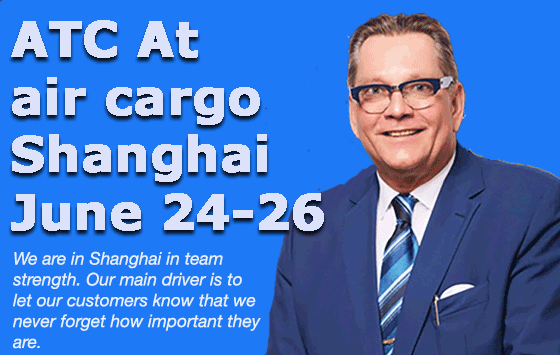
Ingo Zimmr
     
     It’s a tough year, and stepping into a space the size of several football fields, filled with the people and technology next week may feel a bit overwhelming.
     Today we’re talking about transport logistic CHINA 2026, and why it matters for meetups in Asia for logistics, mobility, IT, and supply chain management.
     And if you’ve ever wondered what drives air cargo leaders, road transport innovators, shipping experts, railway planners, and smart logistics teams to actually take off the gloves and cross paths—and puts them all in the same room, same halls, same conversations, same deals happening in real time, well we wondered about that too, so we asked Ingo Zimmer, CEO of ATC Aviation and as usual, he shared some thoughts in simple direct terms.
     ATC Aviation Services AG is the major Cargo GSSA (General Sales and Service Agent) headquartered in Frankfurt, Germany.
     Established in 1971, the company operates as a global salesforce for over 70 airlines, handling air freight capacity sales, market research, and operational management.
     “Here we can see everybody in one go,” Ingo declared.

ATC air cargo CHINA Booth No.     “We will be at air cargo CHINA in team strength.
     “So we invite everyone to stop by and say hello,” Ingo said.
     “Sure we like the idea of ourselves on the half shell in a come-and-get-it situation, but our main driver is letting our customers know that we never forget how important they are.
     “Most supply chains don’t break because of one big dramatic failure. They break because of tiny disconnects—handoffs that don’t sync, data that arrives too late, capacity that suddenly disappears, or a last-mile bottleneck no one predicted.
     “Exhibiting isn’t just about having a stand. It’s about access—direct access to decision-makers, people who can actually buy, partner, or integrate and the chance to show what you do and learn what their expectations are.
     “It’s also about market signals. You learn quickly what trends are real and what’s just buzz.
     “This kind of trade fair is basically designed to hunt down those disconnects.
Conferees can visit us at the Shanghai New International Expo Centre in Hall W5 Stand No. 139, and can go face-to-face with myself, Paul Breburda, Jim (Joe) Carry and Desmond Yau. After they meet with us they can walk from airline air cargo solutions where ATC can fill that need, to road transport systems to shipping and rail, and then into smart logistics.
     “We believe that the Shanghai Cargo event ties it all together.
     “air cargo CHINA will be like getting a glimpse of the entire logistics map instead of just your corner of it.” Ingo Zimmer concluded.
     Elsewhere at air cargo CHINA there’s a Road Transportation and Truck Ecosystem Pavilion, framed as a gateway to what’s next in road transportation.
     That’s a big deal right now, because road freight sits right at the point where cost pressure, sustainability goals, and delivery expectations collide.
     Registration push is pretty clear—secure a free entry by registering online.
     If you’re trying to meet industry leaders and compare solutions fast, being a visitor is the easiest way in.
     Whether you go to discover solutions, meet partners, size up competition, or put your own brand at the center of the conversation, the story is the same: the industry is gathering under one roof, and the doors are open.
     June 24th to 26th, 2026. Shanghai. If logistics is your world, that’s where the next chapter of 2026 could be written.
Geoffrey Arend

chuckles for June 18, 2026

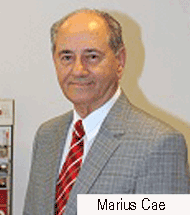
Marius Cae, Juliana Badea

     USER, the Union of Shipping Companies in Romania is a professional organization, established in 1993, which brings together companies with activities covering all modes of transport and related services, including intermodal transport operators, logistics operators and customs brokers. USER has 214 member companies.
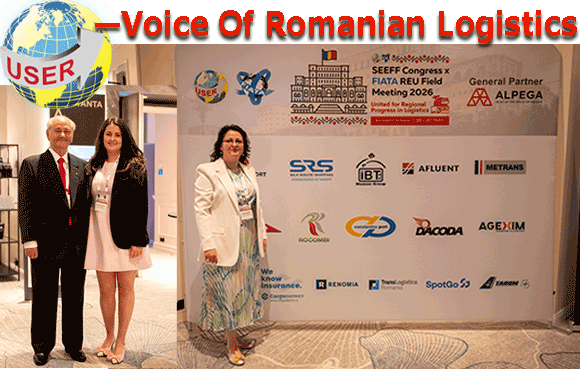
     May 18-20, USER organized and hosted the Congress of the Association of South-Eastern European Freight Forwarders (SEEFF)  & FIATA REU Field Meeting 2026 Congress, a European-wide event, under the slogan "United for Regional Progress in Logistics", bringing together the leaders of associations and companies in the field from 22 countries in Europe and Asia, as well as the top management of FIATA (International Federation of Freight Forwarders Associations).
     During that meeting FT had the opportunity to conduct a three-way interview with (photo left) Marius Cae, President, with Iuliana Badea, Secretary General. and(photo right) Diana Cristescu, Project Manager of USER.

FT:  Congratulations are due for your perfect organization of your conference. Was it a long preparation? How many people worked in this effort in your organization?
Marius CaeUSER:   Thank you very much for your appreciation. Organizing the SEEFF x FIATA REU Field Meeting 2026 – The European Freight Forwarders Congress was a major responsibility and, at the same time, a great honour for USER – the Romanian Freight Forwarders Association.
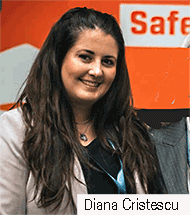
     The preparation process started more than one year in advance. Hosting, for the first time in Romania, an event that combined both the SEEFF Congress and the FIATA Region Europe Field Meeting required extensive coordination at both national and international level.
     Although USER is not a large organization, our entire team was actively involved in the preparation of the congress, together with external collaborators, partners, volunteers and service providers.
     Beyond the operational aspects, a significant amount of work was dedicated to building the conference concept, attracting international speakers and sponsors, coordinating with FIATA and SEEFF partners and creating a valuable networking platform for the logistics community.
     For us, this event was not only about logistics and organization; it was about representing Romania and the Romanian freight forwarding industry at European level in the best possible way.

FT:  Which are the main objectives for USER in organizing a regional conference within FIATA? Is visibility more important than money today? Or else, with due respect to the non-profit nature of your endeavour, does visibility make any money? Which are the most significant contributors and sponsors?
USER:   The main objective was to position Romania and the Romanian freight forwarding sector more strongly on the European logistics map. We wanted to create a platform where industry leaders, freight forwarders, transport operators, authorities and international organizations could exchange ideas, develop partnerships and discuss the future of logistics in Europe.
Diana Cristescu      Of course, visibility is extremely important today. In a highly competitive and rapidly changing industry, visibility creates credibility, trust and opportunities. For an association such as USER, visibility is not an end in itself, but a way to support our members, attract international cooperation and strengthen Romania’s voice within European logistics discussions.

     At the same time, organizing an event of this scale involves considerable financial effort. Sponsorships and partnerships are essential in making such initiatives possible.
     We were honoured to have the support of important partners and sponsors from the logistics, technology, insurance and transport sectors, as well as institutional partners who understood the strategic importance of this congress for the region.
     Beyond direct financial impact, the real value generated by such an event lies in long-term partnerships, business opportunities, industry dialogue and the international exposure gained by Romanian companies.

FT:  Looking at Romanian logistics, can you name the top five issues in Romanian logistics today?
USER:   Romanian logistics has significant growth potential, especially due to Romania’s strategic geographical position. However, there are still several important challenges that need to be addressed:

     1.   Infrastructure development: Although progress has been made, road, rail and intermodal infrastructure still require major investments and better connectivity.
     2.   Intermodal transport development: Romania has strong potential in combined transport, but more terminals, digitalisation and coordinated policies are needed to increase efficiency and sustainability.
     3.   Workforce shortage: Like many European countries, Romania faces a shortage of qualified personnel in transport and logistics.
     4.   Digitalization and regulatory adaptation: Companies must continuously adapt to new European regulations, digital transport documents, customs reforms and cybersecurity requirements.
     5.   Security and fraud risks: Cargo theft, identity theft, fake carriers and cyber fraud have become increasingly serious challenges for the logistics sector across Europe, including Romania.

     Despite these challenges, we strongly believe Romania can become a major logistics hub in the region if investments and strategic policies continue in the right direction.

Juliana BadeaFT:  If you had to discuss the importance of connections in Romania, what would come first, corridors, the Danube or the Black Sea?
USER:   In reality, Romania’s strength comes from the combination of all three elements.
     Romania is strategically positioned at the intersection of major European and international transport corridors, while also benefiting from direct access to the Black Sea and the Danube Corridor. This unique combination offers enormous potential for multimodal and intercontinental logistics flows.
     The Port of Constanța plays a key role as the largest port at the Black Sea and an important gateway connecting Europe with Asia, the Caucasus and Central Asia. At the same time, the Danube remains a strategic inland waterway connecting Romania with Central and Western Europe.
     However, transport corridors are essential because they integrate all these assets into a broader European logistics network. The future lies in connectivity, multimodality and the efficient integration of rail, road, maritime and inland waterway transport.

FT:  Any topic you wish to present/expand, please do so.
USER:   One important message we would like to highlight is that the logistics and freight forwarding industry is no longer only about transport. Today, logistics represents resilience, security, digitalisation, sustainability and international cooperation.
     The challenges facing Europe: geopolitical instability, supply chain disruptions, energy transition, digital transformation and increasing security risks, require much stronger collaboration between the private sector, associations, governments and international organisations.
     Through events such as SEEFF x FIATA REU Field Meeting 2026, USER aims to contribute actively to these discussions and to support the development of a stronger, more connected and more resilient European logistics sector.
     We also believe that South-Eastern Europe deserves a stronger voice within the European logistics ecosystem and Romania has the potential to become one of the key regional logistics hubs in the years ahead.

FT:   Statement about signing of the MoU
USER:   
The signing of the Memorandum of Understanding between USER (The Freight Forwarders Association of Romania) and ETRIA (Eurasian Transport Route International Association) during the congress was also an important milestone for regional connectivity and international cooperation.
     This agreement reflects our common interest in supporting the development of the Middle Corridor and strengthening transport and logistics connections between Europe, the Black Sea region, the Caspian area and Asia.
     For USER, this partnership is fully aligned with our strategic involvement in intermodal transport and international logistics cooperation initiatives. We believe that Romania, through the Port of Constanța and its strategic geographical position, can play an increasingly important role in the development of sustainable and efficient Eurasian transport corridors.
Marco Sorgetti


Emirates Cargo In Cabin

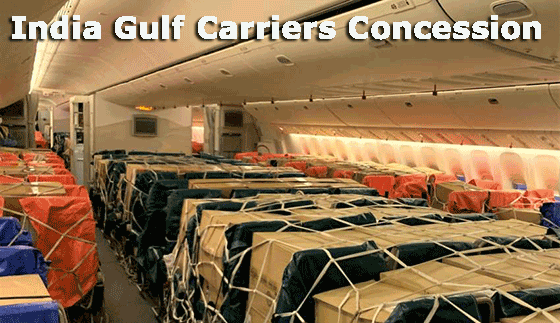
     There's a familiar feeling in the global air cargo business right now, though it comes with a pretty smart, modern update. India's Ministry of Civil Aviation recently made a key change, giving Gulf airlines—big names like Emirates, Kuwait Airways, and Jazeera Airways—special approval to use their passenger planes just for cargo. What's really notable is they can actually load freight right into the passenger cabins. Remember "preighters" being a lifeline when the pandemic hit hard, but this time around, the move addresses a whole new kind of problem: a serious lack of cargo space, largely due to the growing geopolitical tensions in West Asia.
     This whole situation, often referred to as the 'The West Asian Squeeze,' really comes down to how the ongoing crisis in Iran and wider West Asia has completely shifted air travel for the subcontinent. Because of airspace closures and strict rules over places like Iran, Iraq and Jordan, flights heading to Europe and North America now have to take much longer, fuel-intensive routes. For both Indian and international airlines, these stretched-out journeys mean their planes aren't used as efficiently, and there's a lot less space in the cargo holds on those key trade routes.
     At the same time, India's export businesses are really going strong, with steady demand for high-value, time-sensitive goods. So, by letting Gulf carriers use their passenger planes, which might otherwise sit idle, as temporary cargo aircraft, New Delhi is essentially making a practical regulatory move to bring some much-needed capacity into a very tight logistics market. It is no surprise that the focus is on Gulf airlines; these carriers, both because of where they are and how they operate, act as the main hubs connecting Indian manufacturers to the big consumer markets out West.
     For Indian exporters dealing with tight supply chain deadlines, this new policy offers a real boost. Industries that are growing fast—pharmaceuticals, electronics, precision engineering, and anything perishable—are incredibly vulnerable to any hiccups in transit. Imagine a critical shipment of medicine or high-tech microchips getting delayed by just 48 hours because of a scheduling change—the financial fallout could be huge. So, bringing in all this extra cargo space in passenger cabins from Gulf carriers means a more reliable schedule right away, which should also help calm down the cargo rate swings we often see during regional troubles.
     It is important to note that moving cargo from the highly efficient, automated lower hold up into the passenger cabin’s carpeted aisles isn't without its challenges for both ground crews and airlines.
     India’s Directorate General of Civil Aviation (DGCA) has put in place some very strict safety rules for these flights: First, there are strict bans on certain goods. Dangerous items, especially lithium-ion batteries and oxygen tanks, are a ‘No, No’ on the upper deck. Second, everything needs rigorous securing. Cargo has to be carefully fastened down in specific spots—think overhead bins, closets, or even strapped into seats using special, heavy-duty bindings, all to handle any turbulence during the flight. And finally, unlike dedicated freighters with their automatic fire suppression systems, these passenger-to-freight flights must have a mandatory number of crew members onboard in the cabin. Their job is to constantly watch the space and be ready to handle any emergencies as they happen.
     While this policy definitely helps clear up some immediate snags in the supply chain, it also changes things quite a bit for competition. Indian carriers, many of whom are really pushing to grow their international routes and putting money into their own dedicated cargo planes, will now find themselves up against strong competition at home.
     The huge activity of the Gulf carriers, their sophisticated hub-and-spoke network and the very efficient freight network could support a massive volume of business very rapidly. Yet, given the omnipresent Indian uncertainty, reinforced by the Ministry of Civil Aviation vigilance on the geopolitical gamble, the primary task for India is always to support the economy stability. India demonstrates with its decision to adopt a liberal regulation approach rather than leaving protectionism as the only asset, that it is now the time for flexible policies not only in emergency, but as the insurance of a reliable supply chain for the future.
Tirthankar Ghosh


FlyingTypers Ad

If You Missed Any Of The Previous 3 Issues Of FlyingTypers
Access complete issue by clicking on issue icon or
Access specific articles by clicking on article title
FT052826
Vol. 25 No. 27
Atlanta Port Day Report
Chuckles for May 28, 2026
PayCargo Ups Fintech Innovation Down Under
Pfeil At ATC Keeping A Step Ahead
FT060326
Vol. 25 No. 28
How To Weather A CBP Slowdown
EMO Trans Has Got This —Compliance
Chuckles for June 3, 2026
Noida Strategy For Global Trade
FT060326
Vol. 25 No. 29
Riyadh Cargo More Spirit To It
Chuckles for June 10, 2026
Air Canada & Cargospot
DSV Indy Wings
Maritime Melody & Kalé Solutions
Prime Air India Expansion

Publisher-Geoffrey Arend • Managing Editor-Flossie Arend • Editor Emeritus-Richard Malkin
Senior Contributing Editor/Special Commentaries-Marco Sorgetti • Special Commentaries Editor-Bob Rogers
Special Assignments-Sabiha Arend, Emily Arend
• Film Editor-Ralph Arend • Photo Editor-Anthony Atamanuik

Send comments and news to geoffrey@aircargonews.co
Opinions and comments expressed herein do not necessarily reflect the views of the publisher but remain solely those of the author(s).
FlyingTypers reserves the right to edit all submissions for length and content. All photos and written material submitted to this publication become the property of FlyingTypers Media.
Copyright ©2026 FTMedia, Inc. All Rights Reserved.
More@ www.aircargonews.com

recycle100% Green