ATC Aviation Ad

EMO Trans ad
FlyingTypers Logo
#INTHEAIREVERYWHERE
Feed The Children Ad
   Vol. 25  No. 37                                                                        

Tuesday August 25, 2026

linespacer
linkedin
facebook
Instagram
PayCargo Advert

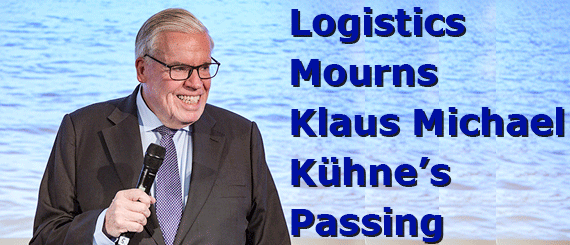
Klaus Michael Kuehne

     Klaus-Michael Kühne, the logistics pioneer and majority shareholder of the freight multinational Kuehne+Nagel, passed away in Schindellegi, Switzerland on August 24th 2026, at the age of 89.
     In a brief obituary Kuehne+Nagel website noted some executive comments in the announcement, “With the passing of Klaus-Michael, we have lost a visionary, a great entrepreneur and an extraordinary personality. Our thoughts are with his widow Christine Kühne.”
     Klaus-Michael Kühne was born in Hamburg in 1937, the grandson of August Kühne, who co-founded the freight forwarding firm Kuehne+Nagel with Friedrich Nagel in Bremen in 1890; the son of Alfred Kühne, Klaus Michael formally joined the family company in 1958, (after an apprenticeship in banking, starting an incredible seven-decade journey.
     In 1966, Kühne stepped up as chairman of the management board for the German operations. In 1975 he took the helm as CEO of Kuehne+Nagel International, eventually moving the company's headquarters to Switzerland.      Thus, the traditional regional forwarder evolved into a global powerhouse. He anticipated the importance of air freight and container shipping for international supply chains long before globalization kicked in. Kühne then served as the Chairman of the Board until 2011, then becoming honorary chairman.
     By then Kuehne+Nagel had become one of the largest logistics and forwarding enterprises in the world, and from that position came acquisitions that completed a constellation of logistics and trade enterprises: Hapag-Lloyd, within a party of local investors, KMK participated in rescuing and securing the container shipping line Hapag-Lloyd to the Hamburg landscape and is Hapag Lloyd’s largest shareholder with a 30% stake; In 2022, he acquired a 17.5% stake in Lufthansa, the German airline carrier, and became its largest single investor. With this, KMK built a major stake in the Lufthansa Group, which includes, Austrian Airlines, SWISS, Austrian Airlines, Brussels Airlines, Eurowings, and ITA Airways.
     He also is a stakeholder in other transportation and trade sectors, including Brenntag and Flix.
     The Kuehne+Nagel group today is one of the world’s leading logistics providers with 88,000 employees across over 1,300 offices in 100 countries.
     The Kühne Foundation, which he created, poured generous resources into education, healthcare research and logistics learning. His fortune and corporate holdings are to be “managed by his charitable foundations, preserving his life's work for public and educational good.”
     One of our friends and logistics pioneer, Issa Baluch, published the following statement today: “Today, we remember Klaus-Michael Kühne.  With deep sadness and profound gratitude, we reflect on a life that shaped Kuehne+Nagel and inspired generations. Through his vision, entrepreneurial spirit and unwavering commitment, he left a lasting mark on our company, our industry and countless people around the world. We honour his extraordinary legacy and extend our heartfelt sympathies to his family and loved ones.”
     Frank Huster, DG of the German federation DSLV published these lines, freely translated from German: “In Klaus-Michael Kühne, the logistics industry loses one of its most influential and fascinating entrepreneurial figures. As a long-standing visionary and driving force, he played a pivotal role in shaping the development of the international freight forwarding business and set benchmarks for entrepreneurial excellence.”
     I personally met Mr. Kuehne several years ago, invited to the Foundation in Germany for a public event when I was working for FIATA. The impact was unforgettable: he gave me the impression we were close, as he knew all that was surrounding my presence there and then for the meeting, he even asked my opinion on topics related to logistics and training. I took it as a great honour, that I was probably not able to reciprocate in any way or manner, because he was clearly so much higher than I was . . .  
     May his soul rest in peace: the world of transport and logistics will be forever indebted by his legacy.
Marco L. Sorgetti


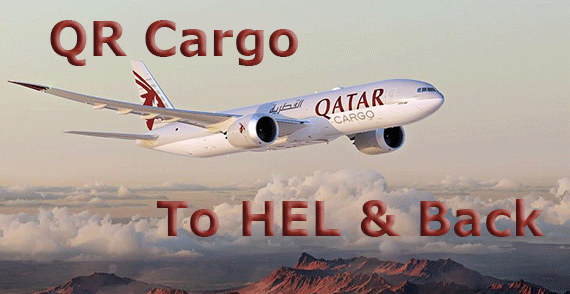
Qatar Helsinki 777 freighter

  Helsinki just got a dedicated freighter connection, not just more space in the belly of a passenger plane, but an actual cargo aircraft designed for air cargo and lots of it!
   Qatar Airways Cargo goes all-cargo Doha (DOH)-Helsinki (HEL), starting September 2, 2026.
   Once a week, a Boeing 777 freighter will operate a loop: Doha to Budapest to Helsinki and back to Doha.
   For exporters in Finland, that adds a fresh 100 tons of cargo capacity out of Helsinki every single week.
   A single flight a week might sound modest until you do the math.   Especially when it stacks on top of the passenger flights already running that route.
   Qatar Airways already flies the Doha–Helsinki–Doha passenger route seven times a week.
   Those widebody passenger flights also carry cargo below deck.
   Add the new freighter, and total weekly cargo capacity from Helsinki climbs to more than 170 tons of more options for shippers.
   So why Helsinki? What makes this airport worth a dedicated freighter in a crowded global cargo market?
   Helsinki is a two-way story.
   HEL exports a mix that’s incredibly time-sensitive and quality-sensitive: high-tech products, electronics, industrial machinery and spare parts, pharmaceuticals and healthcare goods, perishables, and a growing stream of e-commerce.
   HEL imports electronics, consumer goods, automotive components, industrial equipment, and e-commerce shipments.
   DOH offers Finland shippers further access into a huge global network.
Qatar Airways Cargo offers built-in solutions solutions like TechLift for tech cargo, Pharma for healthcare shipments, Fresh for perishables, and Courier for fast-moving shipments.
   Also Qatar Airways Cargo works with Road Feeder Service partners to offer scheduled and on-demand trucking to and from Helsinki, covering Scandinavia and the Baltic region.
   More reach beyond the airport fence, more flexibility, and smoother access into regional markets.
   QR Cargo is also digital booking through their Digital Lounge platform, where customers can reserve space across the network and choose from the full product portfolio.
   Zooming out for a second, the carrier operates more than 60 freighter destinations and over 160 destinations served via passenger flights.
   QR operates 30 Boeing 777 freighters and is the launch customer for the Boeing 777-8F (pictured), with deliveries expected in 2027.
   Flying cargo to HEL & Back isn’t just a new dot on the map to QR, it’s a signal—about serving trade flows between Asia, Finland, and the broader Nordic region, and about where demand for high-value, specialized cargo is growing.
   Adding it up, shippers from HEL get more DOH on their bottom line starting September 2.

GDA/SSA


Ramesh Mamidala

     For years, India has spoken of becoming a global air cargo hub. It has the geography, a rapidly expanding manufacturing base, a huge domestic market and a growing network of modern airports. Yet it has still not been able to perform the role that Dubai, Singapore and Hong Kong have built into the architecture of global trade.
     That question was central to the 7th ACFI World Conclave 2026, recently held in New Delhi under the theme, ‘Reimagining Global Trade: India at the Forefront of Developing Resilient Supply Chains’. More than 700 delegates from across the air cargo, aviation and logistics ecosystem were in attendance. Behind the conference, however, lies a larger ambition: to make India an important node in the changing global trade lanes.
     Ramesh Mamidala, (above) Vice President of the Air Cargo Forum India (ACFI) and Divisional Vice President at Air India, believes India is closer to that possibility than ever before. But he also identifies one of the biggest impediments to its hub ambitions. “The single biggest reason has been our re-screening requirement due to the old TP (Transshipment Policy) which fortunately is changing,” he says. 
     “A successful pilot is underway, and hopefully this will change very soon and our airports will be able to successfully compete [with] the airports you mentioned.”
     That change could prove more important than another new cargo terminal. A hub does not merely handle cargo originating or terminating in its own country. Its real strength lies in attracting international-to-international traffic — cargo simply passing through.
     India's airports have historically been strong in origin-and-destination traffic. The challenge is to persuade a shipper moving cargo between Southeast Asia and Europe, or Asia and Africa, to route it through India rather than established hubs in the Gulf or East Asia. 
     Mamidala sees the opportunity clearly. “This is WIP (Work in Progress), from my perspective,” he says. “Several shippers and agents do find our airlines and airports very attractive as we are geographically well located between SEA/FE (South East Asia/Far East) and ME/EU/UK. Once successfully implemented, our hubs will successfully connect courier, mail, general cargo and perishables across the continents very efficiently.”
     The words “once successfully implemented” are critical. Geography may give India an advantage, but geography alone does not create a hub. India needs a system in which an international shipment can arrive at one airport, transfer to another flight and leave the country without being subjected to processes designed for domestic import or export cargo. “Complete implementation of the new TP policy (Transshipment Permit or Transshipment Bond/Procedure) in its true spirit and develop airside infrastructure to accommodate the anticipated growth in TP volumes of all types — I2I (International to International), I2D (International to Domestic), D2I (Domestic to International) and D2D (Domestic to Domestic),” says Mamidala.
     Today, he acknowledges, transshipment cargo is still treated too much like Indian import/export cargo. “This is the case today but I see this changing positively.”
     The economics matter just as much. India's cargo competitiveness cannot be judged simply by terminal handling charges. The calculation begins at the factory gate and includes trucking, handling, screening, storage, documentation, customs processes and the cost of the final uplift. Mandatory re-screening adds to that cost. “The mandatory rescreening does make [it] more expensive, less competitive, etc. However, as the policy, process and technology change, this situation will change,” Mamidala says.
     Infrastructure remains important, but India must also look beyond established Tier-1 gateways. “To me, it is a combination of all of them," Mamidala says when asked whether infrastructure or processes and regulation represent India’s fundamental problem. “Tier 1 airports have done better on infra, processes and regulations, but now the challenge will be to build and get all of these right in our Tier 2 and Tier 3 airports which is where I personally expect the export growth to come from, helping the country to achieve 10 MMT in about 5-6 years."
     The 10-million-tonne target illustrates the scale of India's ambition. Achieving it, however, will require a considerably more integrated cargo ecosystem. Digitalization is another missing piece. Mamidala believes the solution is already identified in policy discussions. “The solution which also figures in the National Air Cargo Policy Draft is the National Air Cargo Community System. It is high time that we implemented this through PPP mode.”
     The backdrop is favorable. India is benefiting from changing global supply chains, manufacturing diversification and rising e-commerce. But India cannot become a global hub simply by building more capacity. It must build a system in which that capacity can be used efficiently. For Mamidala, the urgency comes from the changing geography of global trade. “With so much happening globally, there is a need to reshape and remodel the air cargo business globally, and very relevant for India as well. I see the trade lanes changing, new hubs are evolving, etc. To facilitate trade in the new global scenario, policies, processes, regulations, systems, etc. need to change.”
Tirthankar Ghosh


Columbia Earthquake Relief

     Latin America stepped up with planes, experts and supplies for the earthquake that hit Colombia earlier this month, reinforcing regional ties, as nations work to safeguard a fragile tourism rebound.
     A 7.4 magnitude earthquake struck western Colombia on August 10, 2026, destroying homes and infrastructure across cities such as Cali and Pereira and remote communities near the Pacific coast. According to reports at least 329 people have been killed, more than 4,600 others injured, leaving 247 confirmed missing and many more have been displaced, as operations continue in collapsed buildings and isolated valleys.
     Teams have been clearing debris and working around damaged roads and bridges.
     Coverage from international and regional outlets describes neighborhoods flattened, power and water networks disrupted and local hospitals operating close to capacity. The scale of the disaster has quickly outstripped local resources, prompting calls for coordinated international assistance from across Latin America and beyond.
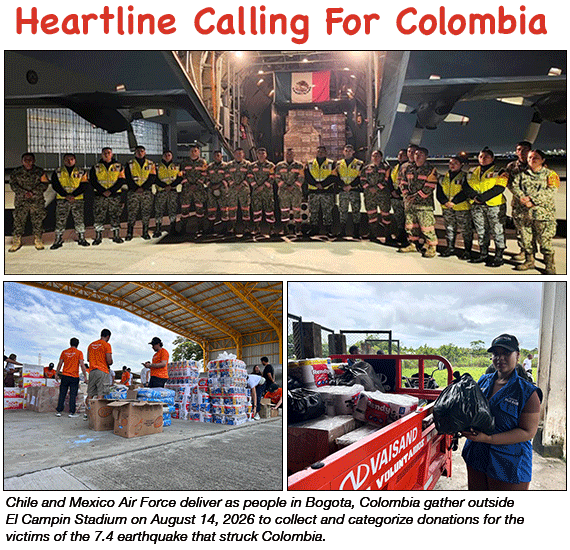
     Into this context, Chile and Mexico emerged as the visible early responders.
     For its part Chile’s own experience with major tremors and tsunamis over recent decades has shaped a disaster management system regarded as among the most technically advanced in the region, giving added weight to its offer of support to Colombia.
     Public statements from Santiago show that Chile organized what officials there describe as a sustained humanitarian air bridge to Colombia.
     Flights were prepared with search and rescue specialists, structural engineers, medical staff and field hospitals, as well as tons of high priority cargo such as water purification units, power generators, shelter materials and medical supplies.
     Mexico’s Armed Forces moved from preparing aid for Colombia to actively delivering it, establishing an expanding humanitarian air bridge to Pereira.
     With roads and bridges damaged in parts of western Colombia, getting help in by ground can be slow or impossible. Air assets can land at bases capable of handling larger transport aircraft, then distribute aid outward. And just as importantly, public information suggests Chile is coordinating through regional emergency channels, aiming to complement what’s arriving from other partners like Mexico, Brazil, and the United States, instead of duplicating the same deliveries.
GDA

Donations help U.S.-based groups on the ground.
All Hands and Hearts has provided search and rescue tools like jackhammers and pickaxes to the Pereira fire department as well as blankets and rehydration supplies for those affected. Link to donate.
CARE has a longtime presence in Colombia. Its immediate support will focus on food assistance through cash and vouchers, emergency supply care packages, and protection and emotional support for affected families. Link to donate.
Direct Relief is funding medical responders on the ground and preparing to deliver requested medications and healthcare supplies. Link to donate.
GEM is joining with local partners to provide essential kits with food, water, and hygiene necessities. Link to donate.


FlyingTypers Ad
If You Missed Any Of The Previous 3 Issues Of FlyingTypers
Access complete issue by clicking on issue icon or
Access specific articles by clicking on article title
FT072826
Vol. 25 No. 34
NMIA Radiness Comes Under Scrutiny
Faces That Helped Lift Venezuela
They Drive Miles & India Smiles
India's Three-Point Cargo Strategy
FT081326
Vol. 25 No. 35
Jan Krems Retiring, Chris Busch Appointed
India's Invisible Airline
Chuckles for August 13, 2026
Rick Elieson—What Is Great Leadership?
FT082026Vol. 25 No. 36
FIATA Celebrates 100 Years In October
PayCargo Accelerates Menzies Quick Pay
Happy National Aviation Day Orville


Publisher-Geoffrey Arend • Managing Editor-Flossie Arend • Editor Emeritus-Richard Malkin
Senior Contributing Editor/Special Commentaries-Marco Sorgetti • Special Commentaries Editor-Bob Rogers
Special Assignments-Sabiha Arend, Emily Arend
• Film Editor-Ralph Arend • Photo Editor-Anthony Atamanuik

Send comments and news to geoffrey@aircargonews.co
Opinions and comments expressed herein do not necessarily reflect the views of the publisher but remain solely those of the author(s).
FlyingTypers reserves the right to edit all submissions for length and content. All photos and written material submitted to this publication become the property of FlyingTypers Media.
Copyright ©2026 FTMedia, Inc. All Rights Reserved.
More@ www.aircargonews.com

recycle100% Green