ATC Air Cargo Shanghai Ad


EMO Trans ad
FlyingTypers Logo
#INTHEAIREVERYWHERE
Feed The Children Ad
   Vol. 25  No. 29                                                                         

Wednesday June 10, 2026

linespacer
linkedin
facebook
Instagram
PayCargo Advert

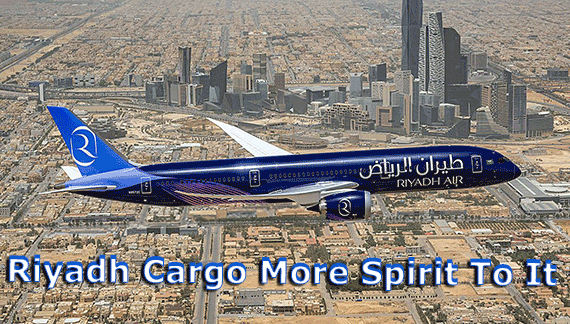
Riyadh Air

     Picture this. It’s 2026, and a brand-new airline is taking off from Saudi Arabia with a goal that’s bigger than just flying people from one city to another. It also wants to change how the world moves goods, and it wants to do it from Riyadh.
     And when you hear “Riyadh,” it almost has a rhythm to it—which is apt, because the word traces back to gardens and greenery.
     But in the planning rooms, Riyadh means something else now: a capital with serious aviation ambition.
     Today, we’re not focusing on the cabin design or the hype around a massive aircraft order.
     We’re going underneath the passenger schedule, into the cargo hold, where the real pressure lives. Because this airline isn’t treating freight as a quiet side hustle.
     Alongside Riyadh Air, there’s a dedicated freight identity: Riyadh Cargo, and that naming choice matters—because in logistics, nobody wants “also, we do cargo.” They want a clear product, clear responsibility, and clear systems.
     So let’s set the scene in our story.
     The first chapter isn’t some grand, instant worldwide network. It’s the early build—choosing partners, choosing lanes, and proving the operation in the real world, shipment by shipment.
     That’s where the recent move comes in: appointing General Sales and Service Agents (GSSAs) in three key markets—Egypt, India, and the UAE. Those aren’t random dots on a map. They sit right next to some of the world’s busiest trade corridors linking Asia, the Middle East, Africa, and Europe.
Pravin Singh

     “We’re building our service network with local partners who understand their markets,” declared Pravin Singh, VP of Cargo at Riyadh Air and Head of Riyadh Cargo.
     What we liked immediately about Pravin were his first words upon assuming his position last year:
     “The prospect of creating a new cargo business with a blank canvas, using technology and innovation as primary tools is hugely exciting.” Right away, Riyadh Cargo—with more spirit to it—felt like a breath of fresh air.
     For India, Riyadh is working with Air Logistics Group India. In the UAE, it is Cargo Partners International operating under dnata Cargo.
     For Egypt, the GSSA designate is M&C Aviation Group, and the list goes on and will be expanded.
     “Sensible” is the way Riyadh describes the rollout: phased activation.
     Not flipping a switch everywhere at once.
     More like, “We’ll turn each market on when it’s ready—when the network can actually support it.”
     That’s a very different tone from the usual launch-driven bravado.
     Because cargo is unforgiving.
     If passenger service disappoints, people complain.
     If cargo service disappoints, supply chains snap.
     A missing pallet doesn’t just annoy someone—it can shut down a production line or ruin a shipment of fresh goods.

   As we go to Press, Riyadh Air is serving London Heathrow (LHR)with daily flights that launched today June 10th and bookings are available on the website and mobile app.
  Dubai International (DXB): Daily service bookings are open with June 18th launch date for a second daily service in the Riyadh schedule.
  Cairo, Madrid, and Manchester expansion hubs are set to follow quickly through the rest of the summer.

     Examining the markets that Riyadh Cargo is building in reveals a strategy.
India delivers scale and consistent demand. The UAE brings connectivity and forwarder ecosystems. Egypt opens doors across key lanes and adds growth potential, including more direct routing that shippers love because it cuts time and handoffs.
     Now, let’s talk about the character at the center of this cargo storyline: leadership.
Mr. Singh, describing the cargo opportunity as a blank canvas, also notes technology and innovation first—not as a bolt-on later.
     That’s a big statement, because legacy cargo systems can be… let’s just say, complicated.
     He keeps coming back to this idea: global reach, local execution. Meaning you can dream about worldwide cargo flows all you want, but if the handling, documentation, and communication aren’t sharp on the ground in each market, you’re dead in the water.
     So what does Riyadh Cargo actually move right now?
     One of the early proving routes is Riyadh to London Heathrow.
     Heathrow isn’t a friendly practice field. It’s high-volume, high-expectation, and operationally intense.
     The goods Riyadh Cargo has already carried on that lane tell you what kind of performance they’re chasing: garments and textiles, fresh flowers, seafood, tea, and coffee.
     That’s not just a random list. Flowers and seafood are a timer—if you’re late, the product loses value fast. And it’s not enough to just deliver.
     “Shippers want trackability, forwarders want predictability, everyone wants fewer surprises—and when disruptions happen, they want visibility and fast answers.”
     Which brings us to the phrase used by Riyadh Cargo for this early stage: “a pathway to perfect.”
     Not perfect on day one.
     More like: start operating, learn from real shipments, tighten the process, then scale.
     That’s a mature approach, because reliability doesn’t come from announcements. It comes from repetition—doing the same thing correctly again and again until it’s a system, not a heroic effort.
     Now, the backbone of this story is digital capability.
     Riyadh Cargo wants to be tech-led from day one, with dedicated cargo management systems and centralized control over airwaybills. That’s one of those “boring” details that becomes priceless when volumes rise or the network gets stressed.
     So, Riyadh Cargo is partnering with CHAMP’s Cargospot neo Platform, designed to run cargo operations end-to-end. And digitization isn’t only about software dashboards. The carrier is also investing in digitally tracked ULDs—those cargo containers and pallets that constantly go missing across the industry.
     For that, they’re working with Unilode.
     It signals something important: equipment visibility isn’t being treated as a nice-to-have. It’s being treated as service reliability—and even sustainability—because fewer lost units means fewer inefficiencies.
     But you can’t digitize your way out of bad ground handling. So on the ground, Riyadh Cargo is working with SATS in Saudi Arabia.
     Riyadh is the primary hub, with services extending across key airports like King Khalid International in Riyadh, King Fahd International in Dammam, and King Abdulaziz International in Jeddah.
     Outside Saudi Arabia, Riyadh Air has lined up additional partners too. Worldwide Flight Services at London Heathrow is a major one.
     They’ve also secured partnerships in Pakistan, Sri Lanka, the Maldives, Bangladesh, and the UK—supporting both online and offline sales, including in Manchester.
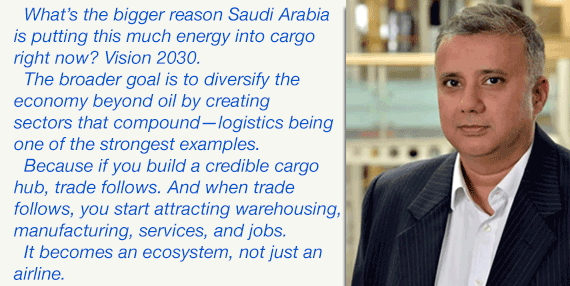
     So if we zoom out, what’s the bigger reason Saudi Arabia is putting this much energy into cargo right now? Vision 2030.
     The broader goal is to diversify the economy beyond oil by creating sectors that compound—logistics being one of the strongest examples.
     Because if you build a credible cargo hub, trade follows. And when trade follows, you start attracting warehousing, manufacturing, services, and jobs. It becomes an ecosystem, not just an airline.
     Riyadh Air’s overall growth plan is huge—building toward a major fleet and a network that aims for more than 100 destinations by 2030.
     No doubt you’ll hear big economic expectations around it too: major non-oil GDP contribution and hundreds of thousands of jobs tied directly and indirectly to the airline’s expansion.
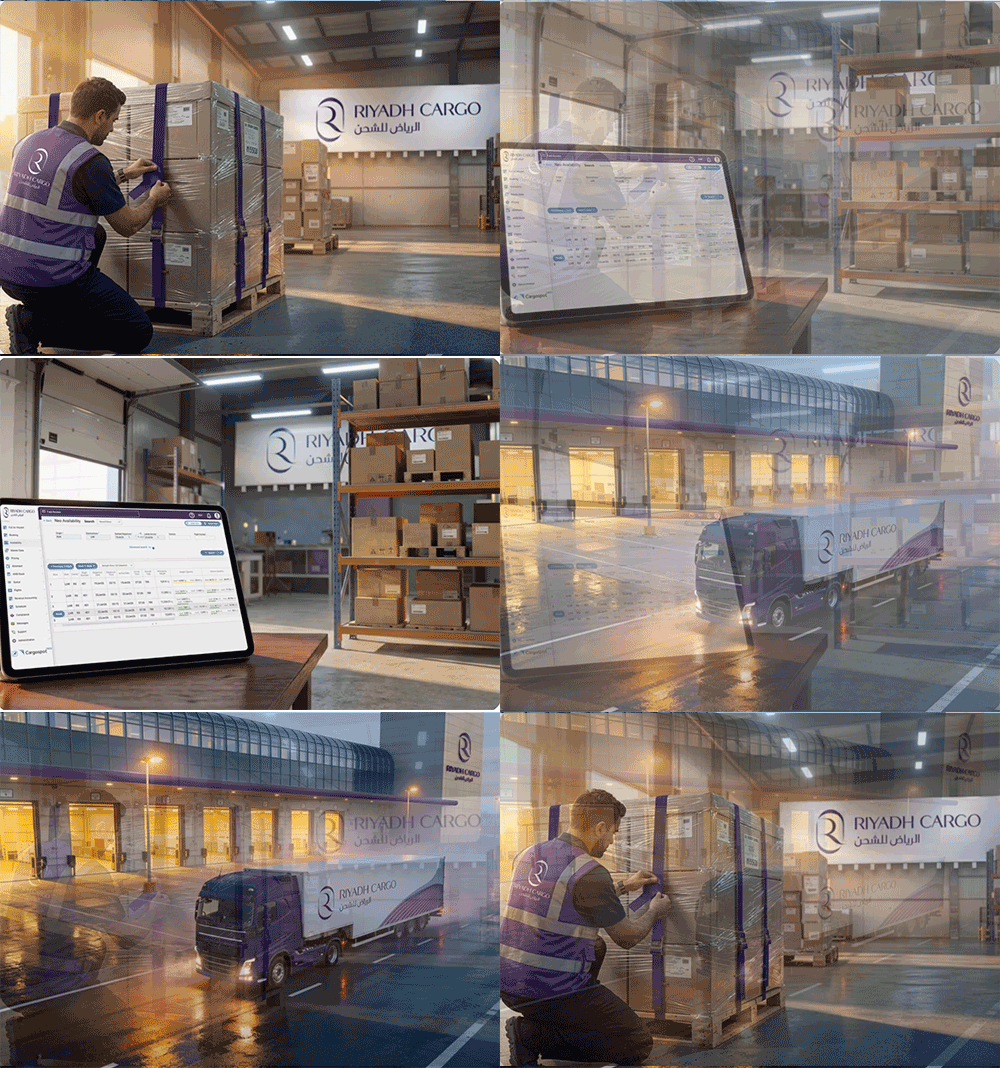
Riyadh Cargo

     Here’s a key point not to be forgotten: cargo isn’t a decoration in the big picture.
Cargo helps make the network work financially by supporting route economics year-round.
     Air cargo makes the hub valuable not only to tourists and business travelers, but to global supply chains that run every day.
     Also, a separate cargo identity—Riyadh Cargo—creates a clear signal to forwarders and shippers: this is a focused operation, with leadership, systems, and accountability.
     In logistics, that clarity can be the difference between an “interesting press story” and a “trusted partner.”
     So what is the takeaway as we wrap up?
     •   Riyadh wants to become a connector city, not just a destination.
     •  The cargo business is ramping up in a controlled way—prove it on live lanes like Riyadh–London, then expand without losing the basics.
     •  The strategy leans heavily on digital foundations: cargo management platforms, centralized data, and trackable ULDs.
     •  It’s tied tightly to a national objective—making Saudi Arabia a global aviation and logistics hub before the decade is over.

     And the real tension in this story—the part everyone will be watching—comes down to one question: can Riyadh Cargo scale fast without letting service quality wobble?
     For now, the signal is clear. Riyadh Air wants cargo in its identity from the start, and Riyadh Cargo is being built as a tech-forward engine to turn big national ambitions into day-to-day operational reality. More power to them.
Geoffrey Arend


Chuckles for June 10, 2026

Pumping Traffic News
Matthieu Casey, Manuel Galindo, Janet Wallace, Nicholas Xenocostas

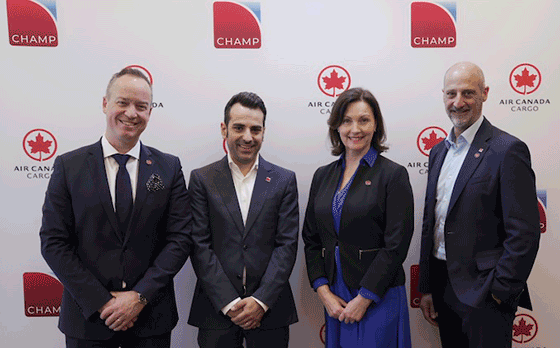
     CHAMP Cargosystems’ Cargospot takes over as the core of Air Canada Cargo’s new cargo management system, spanning operations, commercial, and selected
revenue accounting functions.
     At the heart of this transformation is Cargospot neo Airline, CHAMP’s reimagined flagship cargo management system. In addition to Cargospot neo Airline, Air Canada Cargo will also integrate Cargospot neo Handling, Cargospot Mobile and Cargospot neo Revenue Accounting to streamline operations and operate a fully connected, real-time model.
     Pictured making the annoucement (from left) Matthieu Casey, Managing Director, Commercial - Cargo, Air Canada; Manuel Galindo, CEO, CHAMP Cargosystems; Janet Wallace, Managing Director Cargo Operations & Transformation, Air Canada and Nicholas Xenocostas CCO, CHAMP Cargosystems . . .

Martin Donlin Mural
     'Indy Wings' is DSV Global Transport’s Air ThermoDirect (ATD)  brand for moving highly sensitive pharmaceutical, healthcare, and life-saving medical products between Luxembourg and Indianapolis International Airport.
Kenneth Källström     “Greater speed, reliability, and integrity — ultimately deliver better outcomes for patients worldwide,” assured Kenneth Källström, Executive Vice President, Global Head, Healthcare, DSV.

     “'Indy Wings' reflects our strategy to bring the critical points of the supply chain under full accountability, ensuring reliability, integrity and performance where it matters most,” noted Stephanie Penarete, DSV VP Air Product Americas.
     Speaking of 'Indy Wings', 'Indiana Windows' by British artist Martin Donlin are 14 large, colorful floor to ceiling abstract murals made of hand-blown glass panels in the passenger terminal at Indianapolis International Airport.
     The murals with poems inspire thoughts of home and safety, including one titled 'Back Home', by Norbert Krapf,

“Back home on the ground we discover that the gift the great wings gave us is new eyes to see that this place where we live, we love more than we knew."
     
      Indianapolis is also home to Pharma giant Eli Lilly with revenue of USD$72.250 billion for the twelve months ending March 31, 2026.

     At TIACA’s recent Executive Summit in Warsaw, Poland, Kalé Logistics Solutions said that it will combine its cloud-based air cargo technologies with e-Smart Logistics.
     The move, Kalé said improves real-time visibility and transparency at piece or stock-keeping unit (SKU) level, making things easier for airlines to provide end-to-end visibility for e-commerce and high-value vertical products.
     This capability extends to other verticals, including healthcare, aerospace, automotive and valuables.
     The partnership will integrate Kalé’s AvSys cross-border e-commerce
platform launched earlier this year, which enables piece-level tracking and supports operational compliance.
     “E-commerce and high-value shipments continue to be growing verticals for the air cargo industry, and shippers are demanding more visibility for each package,” said Amar More, Co-Founder and Chief Executive, Kalé Logistics Solutions.
     “This partnership provides airlines with the tools to enhance their product portfolios, allowing them to compete for traffic by offering the piece and parcel-level visibility demanded, and the service quality shippers expect.”

Maritime Melody & Kalé Solutions
Donna Mullins, Amar More, James Murphy     Reflecting upon an incredible week at the U.S. Forum on Indian Ocean Ports and Supply Chains in Washington, D.C., on June 2, Amar More, Co-Founder and Chief Executive Officer of Kalé Logistics Solutions (right) is pictured with James Murphy of Daybreak Strategies (left) and Donna Mullins, Vice President Kale Logistics Solutions (center).
     “It was an absolute privilege to engage with officials from the U.S. Department of State, U.S. Department of Transportation, U.S. Customs and Border Protection, U.S. Coast Guard and U.S. Maritime Administration, as well as delegates from the Ministries of Commerce, Shipping, and Finance, along with several port authorities from India, Sri Lanka, Bangladesh, and the Maldives,” Amar declared.
     “The discussions were insightful, and the organization of the event was superb. The private sector had the opportunity to showcase transformational solutions for the Maritime Industry, paving the way for partnerships that are set to grow and solidify further.
     “Kalé Logistics Solutions was pleased to discuss the critical need for digitization and the significant roles that Next Generation Port Community Systems, Maritime Single Window Systems, Digital Twins, and AI play in the digital transformation of the industry.
     “Looking forward to the next meeting next year!” Amar concluded . . .


FlyingTypers Ad
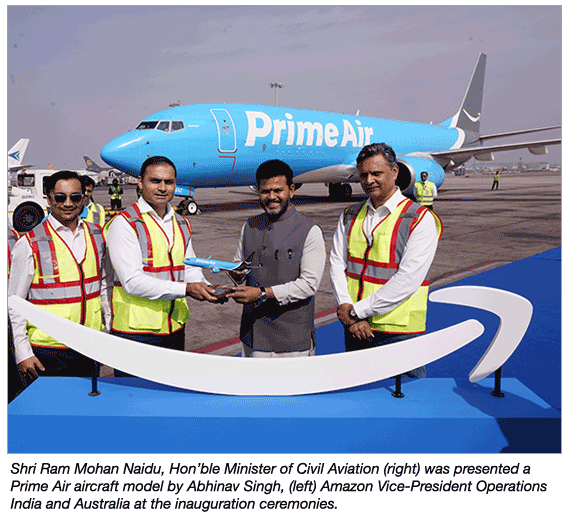
Shri Ram Mohan Naidu. Abhinav Singh

     In March 2026 Amazon Air expanded its operational footprint into Northeast India as part of a major scaling of its domestic logistics network. The company is now operating a dedicated cargo corridor linking Guwahati and Kolkata with major fulfilment hubs such as Delhi and Bengaluru.
     This expansion represents an important step forward for Amazon as it helps broaden the coverage of their specialized air network focused on e-commerce deliveries.
     Amazon Air has introduced freighter flights into Guwahati, creating a regional logistics hub for the seven Northeastern states — Arunachal Pradesh, Assam, Manipur, Meghalaya, Mizoram, Nagaland, and Tripura.
     The first Amazon Air flight to Guwahati was inaugurated by Union Minister of Civil Aviation, Government of India, Kinjarapu Ram Mohan Naidu, alongside Amazon executives and state officials. “Given the Northeast’s immense potential in horticulture and cargo exports, the launch of this cargo route will further support farmers, artisans and entrepreneurs of the region,” the minister said, noting that air connectivity in the Northeast has grown significantly in the past decade.
     Operational airports in the region have increased from nine in 2014 to 16 today, reflecting the government’s wider “Act East” connectivity strategy. 
     Amazon is the first e-commerce company in India to operate a dedicated air cargo network, reaffirming its long-term commitment to strengthen its transportation infrastructure in India. Amazon Air provides network branding and logistics platform while QuikJet operates the aircraft and manages the flight operations. The company has been operating two Boeing 737-800BCF (Boeing Converted Freighters). Each has a capacity of roughly 22 tonnes of cargo across 12 main-deck pallet positions.
     These aircraft are particularly suited to e-commerce logistics primarily for their medium payload capacity, which is ideal for parcel traffic, high utilization with multiple overnight rotations, and narrow-body efficiency allowing access to secondary airports.
     Industry observers say the aircraft type offers an optimal balance for the high-volume, low-density shipments typical of e-commerce.  Amazon aircraft links several hubs on a single rotation by trans-shipping and using Amazon’s multimodal capabilities.
     Recent flight patterns show aircraft operating sectors across Delhi, Bengaluru, Mumbai and Kolkata before continuing to Guwahati, maximizing aircraft utilization and minimizing empty legs. For decades, Northeast India has faced persistent logistics constraints because of geography.
     Surface cargo must pass through the narrow Siliguri Corridor, often referred to as the “Chicken’s Neck”, which links the region to mainland India. Seasonal weather disruptions, terrain and limited rail capacity have historically slowed freight movement.
     The introduction of dedicated freighter capacity changes that equation. Shipments that previously took seven to nine days via road or rail can now move through an overnight air-to-surface model, with parcels flown into Guwahati and distributed across the region by road.
 Dr. Ravi Kota    According to Amazon, the integrated air and ground network will improve delivery speeds by up to five times across the Northeast. The logistics improvement could have a broader economic impact across the region. Faster transport links allow businesses in the Northeast — particularly those dealing in horticulture, specialty produce, handicrafts and artisanal goods — to access markets across India more reliably.
     Dr. Ravi Kota, Chief Secretary of Assam, said the service would help expand market access for local entrepreneurs. “Enhanced logistics connectivity plays a crucial role in empowering local businesses and expanding market access for enterprises across the Northeast,” he said. Improved fulfilment speeds will allow regional sellers to reach customers nationwide while also supporting employment and economic growth in the region. 
     Amazon launched Amazon Air in India in 2023, creating the country’s only dedicated e-commerce air cargo network.
     The system combines:
                 Dedicated freighters
                 Belly cargo partnerships with passenger airlines
                 Multimodal connections
                 A nationwide road logistics network
     The network now connects over 100 origin-destination pairs across India and serves five cities with freighter capacity and over 40 cities via multimodal networks. Amazon’s overnight routes link major metros including Delhi, Mumbai, Bengaluru, Kolkata and Guwahati, enabling rapid fulfilment for Prime deliveries.
     Abhinav Singh, Amazon’s Vice-President for Operations in India and Australia, said the Northeast expansion reflects the company’s long-term investment in logistics infrastructure. “The expansion of Amazon Air to the Northeast is a natural progression of our investments in India’s logistics network. Customers will gain access to Amazon’s selection at speeds up to five times faster than before, while sellers in the region can reach customers nationwide more reliably,” he said.
     India’s recent budget for 2026 places clear priority on boosting air cargo infrastructure, and the expansion we’re seeing fits right into that strategy. The government is putting money into upgrading cargo terminals and cold-chain warehousing, improving facilities for perishable and high-value exports, and removing limits on courier export values—all moves designed to fuel cross-border e-commerce. Naturally, these steps are likely to raise the demand for dedicated freighter capacity within the country.
     It’s not only about logistics, that dedicated freighter services introduced in Guwahati will help to improve, it is a step that shows that e-commerce air cargo networks integrating pan-India are becoming a reality. In this regard airlines logistics providers, and digital marketplaces cooperate within the same unified supply chains. For Amazon, this development is a clear sign of how a small specialized cargo airline can be a game changer in the Indian logistics industry by linking distant regions, delivering goods faster, and enabling the growth of the digital commerce sector in the country.
Tirthankar Ghosh


If You Missed Any Of The Previous 3 Issues Of FlyingTypers
Access complete issue by clicking on issue icon or
Access specific articles by clicking on article title
FT051926
Vol. 25 No. 26
Fried Keynotes CNS Partnership
Rajni Patwardhan Rebranding Kale
Bangaranga Rhythms At SEEF
FT052826
Vol. 25 No. 27
Atlanta Port Day Report
Chuckles for May 28, 2026
PayCargo Ups Fintech Innovation Down Under
Pfeil At ATC Keeping A Step Ahead

FT060326
Vol. 25 No. 28
How To Weather A CBP Slowdown
EMO Trans Has Got This —Compliance
Chuckles for June 3, 2026
Noida Strategy For Global Trade

Publisher-Geoffrey Arend • Managing Editor-Flossie Arend • Editor Emeritus-Richard Malkin
Senior Contributing Editor/Special Commentaries-Marco Sorgetti • Special Commentaries Editor-Bob Rogers
Special Assignments-Sabiha Arend, Emily Arend
• Film Editor-Ralph Arend • Photo Editor-Anthony Atamanuik